Home » Stainless Steel vs Carbon Steel Stud Bolts
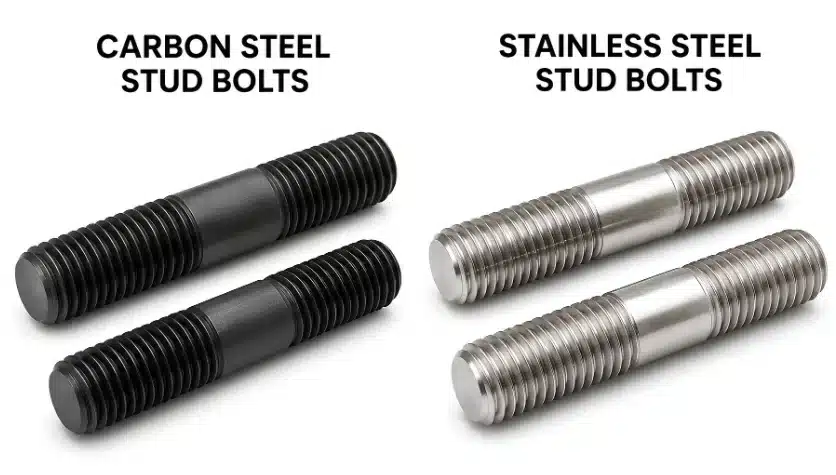
Whether the project is an oil and gas pipeline in Abu Dhabi or a structure in Dubai, the wrong choice of bolting material can lead to early failure, unplanned downtime, and several other safety risks. In this article, we’ll compare the stainless steel and carbon steel stud bolts based on the strength, corrosion resistance, temperature performance, and typical applications. The comparison will help you to match the right material according to your project requirement.
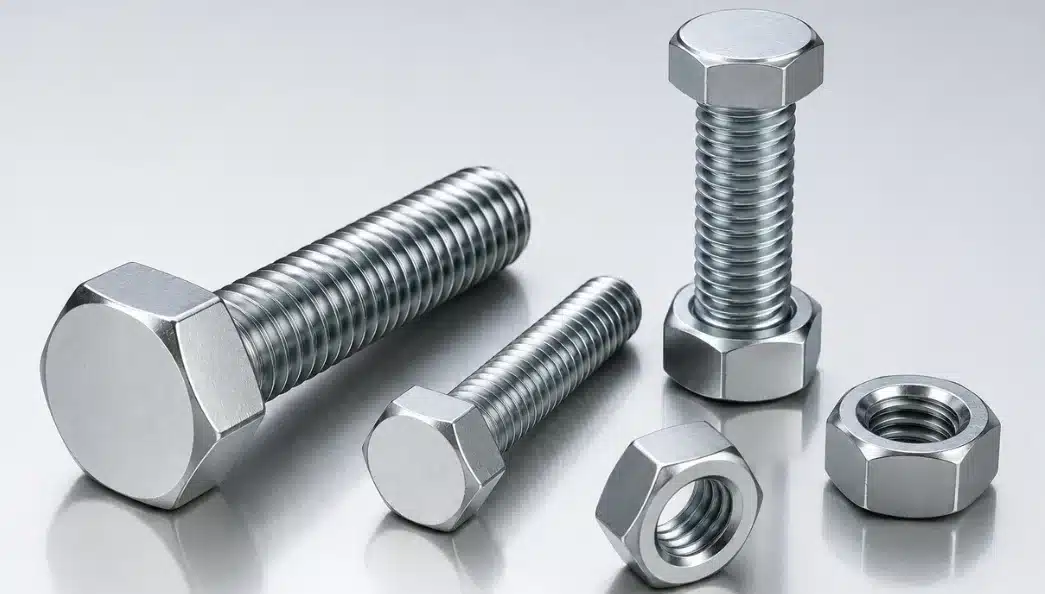
A stud bolt is a fully threaded or double-ended rod with no integral head, tightened with a nut on each end. It is used mainly in flange connections, which sets it apart from a regular hex or structural bolt.
Who We Are: Petrofast Middle East FZC is a trusted fastener manufacturer and supplier in the UAE. We manufacture stud bolts and relevant fasteners to international standards, including ASTM and ISO specifications.
Stainless stud bolts are fully threaded rods designed from corrosion-resistant stainless steel grades. The corrosion resistance of these stainless stud bolts originates from chromium, which produces the passive chromium oxide layer on the surface which sets a limit for the contact between the base metal and oxygen/ moisture to make the stud bolts usable under a suitable environmental condition without any additional coating.
Carbon and alloy steel stud bolts are widely used in industrial flange and pressure-containing connections. In everyday industrial bolting, one often uses the designation ‘carbon steel’, but it must be known that types like ASTM A193 B7 and B16 are actually chromium-molybdenum alloy steels, hardened for high tensile strength.
Such studs may be offered with either hot-dip galvanized (HDG), PTFE, electro-zinc, yellow passivated, phosphate, or electroless nickel plated (ENP). The coatings increase the lifespan of studs under outdoor conditions and in mildly corrosive settings.
|
Feature
|
Stainless Steel Stud Bolts
|
Carbon Steel Stud Bolts
|
|---|---|---|
|
Corrosion Resistance
|
High, due to the passive chromium oxide layer; performance depends on grade and environment
|
Moderate to low; generally requires a coating such as HDG, PTFE, ENP, or zinc
|
|
Tensile Strength
|
515 to 860 MPa depending on grade and standard (e.g., ASTM A193, ISO 3506-1)
|
ISO 898-1 CL 12.9: up to 1220 MPa. ASTM A193 B7: 860 MPa, within its specified diameter range
|
|
Hardness
|
ASTM A193 B8/B8M Class 1: 223 HBW max.; Class 2: 321 HBW max.
|
ASTM A193 B7: up to 321 HBW. ISO 898-1 CL 12.9: 39 to 44 HRC
|
|
Temperature Range
|
Grade 310/310S suits high-temperature service; duplex grades suit moderate temperatures
|
ASTM A193 B7 / B16 are specified for elevated-temperature flange service
|
|
Low-Temp Performance
|
Austenitic grades (A2/A4) retain good toughness at low temperatures; duplex grades are suited down to about -46 °C
|
ASTM A320 L7 is impact-tested to -101 °C (27 J minimum)
|
|
Typical Applications
|
Offshore, marine, chemical processing, desalination
|
Oil and gas flanges, pressure vessels, heat exchangers, high-load joints
|
|
Initial Cost
|
Generally higher
|
Generally lower
|
|
Service Life (Harsh Environments)
|
Long in suitable grades; low maintenance
|
Depends on coating quality and maintenance
|
|
Available Coatings
|
Bright finish as standard; PTFE available
|
HDG, PTFE, ENP, Zinc Nickel, Yellow Passivated, Black
|

Super Duplex grades (S32750 / S32760) offer tensile strength up to 860 MPa, equal to B7, but with improved corrosion resistance. These are serious heavy-duty stud bolts. Compromise on neither front.
Chloride exposure is the primary corrosion concern in coastal infrastructure, desalination facilities, and offshore platforms. There is no coating to deteriorate or wear away since stainless grades like 316L and duplex rely on a passive chromium oxide layer instead of an applied coating. A grade that is too low for the chloride level may experience pitting or crevice corrosion; therefore, choosing the right grade is still important.
Super duplex grades (S32750 and S32760) combine strong chloride resistance with excellent tensile strength. They are suitable for heavy-duty flange connections where corrosion is a concern since their strength can approach that of ASTM A193 B7, depending on grade, diameter, and applicable standard.
The use of stainless stud bolts on worldwide EPC project requirements is supported by ASTM A193, ASTM A276, and ISO 3506-1 (A2-70, A4-70, A4L-70, A4-80, A4L-80).
Compared to coated carbon steel in corrosive service, stainless steel stud bolts can minimize the requirement for inspection, recoating, and replacement for large flange assemblies in industrial zones. The environment, maintenance procedures, and grade all affect the lifespan benefit.
Tensile strength up to 1220 MPa, one of the greatest in standard fastener property classes, is provided by ISO 898-1 property class 12.9. Because of this, it can be used with machines and high-load mechanical joints. Coating and process selection must be careful at these strength levels because hydrogen embrittlement is known to be a problem, especially with electroplated finishes.
Due to the ASTM A320 L7 and L43 grades being impact-tested at -101 °C with a minimum of 27 J, they are frequently specified for LNG plants and other cryogenic services where low-temperature impact toughness is necessary.
Large-scale projects can benefit from the cheaper initial cost of carbon and alloy steel stud bolts. Together with the purchase price, coating and maintenance expenses over the course of the service life should be taken into account.
For outdoor and mildly corrosive situations, hot-dip galvanizing (HDG) offers a long-lasting zinc barrier; PTFE and ENP coatings offer advantages in terms of corrosion or friction. The chosen bolting grade and hardness for sour-service applications should meet the relevant NACE MR0175 and ISO 15156 standards for the particular service environment; coatings may improve corrosion or friction but do not prove sour-service compliance on their own.
Stainless steel stud bolts are used on wellhead assemblies, subsea pipes, and offshore platforms where corrosion resistance is crucial due to continuous exposure to chlorides. The project specifications and the temperature of the seawater determine the grade (such as duplex or super duplex).
High-chloride brine, which may rapidly corrode regular carbon steel, is handled by desalination units. In these flange connections, stainless and duplex stud bolts are frequently utilized, with the grade selected to accommodate temperature and chloride content.
Stainless stud bolts are used on piping flanges exposed to corrosive process fluids in refineries and chemical plants. Temperature, concentration, and the particular chemical all affect suitability. Alternatively, a nickel alloy may be chosen for extremely hostile media, including strong acids.
Wave splash and salt spray are frequent threats to loading arms, piers, and docks. Although crevice corrosion should be taken into account in joints that drain poorly, stainless stud bolts prevent corrosion in these marine-facing connections.
Class 150 to Class 2500 B16.5 flanges employ stainless stud bolts, which are usually combined with ASTM A194 Grade 8M nuts.
Pressure vessel and heat exchanger flange assemblies, including elevated-temperature use, frequently useASTM F3125 B7/B16 stud bolts.
For LNG, cryogenic, and cold-climate applications where impact toughness at low temperatures is necessary, ASTM A320 L7 stud bolts are recommended.
ISO 898-1 property classes 10.9 and 12.9 are used in heavy machinery and high-vibration assemblies.
CL 10.9 and CL 12.9 industrial fasteners UAE for machinery, heavy equipment and high vibration assemblies.
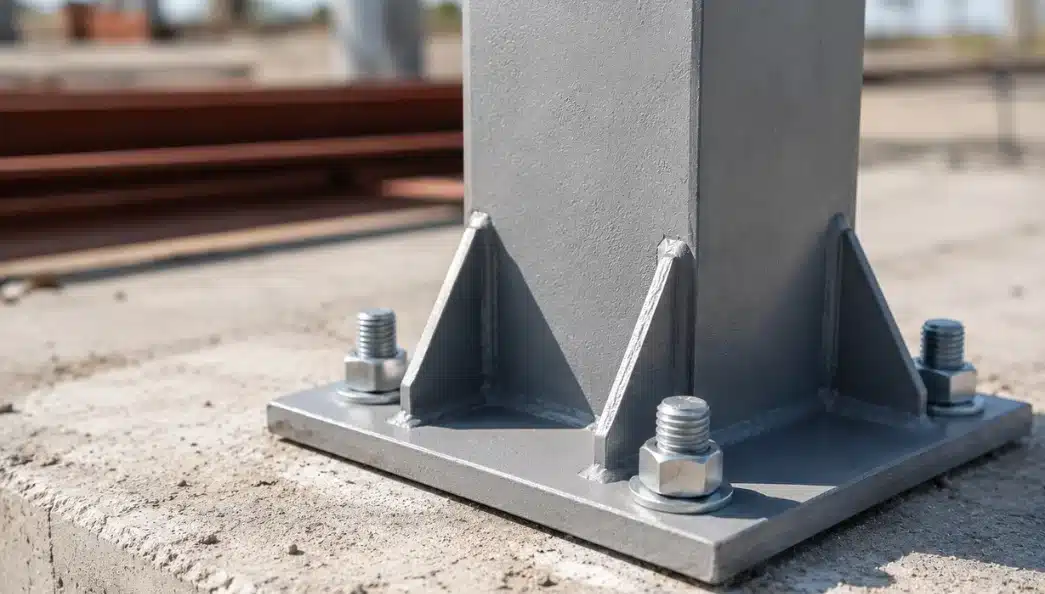
Column bases and equipment foundations use ASTM F1554 Grades 36/55/105 threaded anchor rods, which are available in HDG or black finish. These are not flange stud bolts; rather, they are a similar but different anchoring product.
No single material is ideal for all applications. The service environment, temperature and pressure, load, and project specifications all influence the best option. When each material is usually chosen is summarized in the framework below.
The grade of fastener will have to conform to the load, pressure, and operating conditions for each assembly of flanges. Petrofast Middle East FZC, from its ISO 9001:2015 certified factory in Sharjah, has been assisting engineers, purchasing departments, and EPC contractors across the UAE and GCC region for over two decades.
Before you issue the purchase order, our in-house factory is equipped with ISO 17025 laboratory tests, material traceability, and technical expertise to confirm your grade. Need help selecting the appropriate stud bolt grade for your project? Share your specifications, drawings, materials, or service requirements with the technical team at Petrofast.
Chromium forms a passive film of chromium oxide that can regenerate itself when it is slightly damaged, making stainless steel rust-resistant. Stainless steel is not immune to corrosion but is corrosion-resistant. The choice of the grade (304, 316, duplex, or super duplex) should depend on the operating environment and not on a blanket decision since the wrong grade can be subject to pitting and crevice corrosion in a highly corrosive chloride environment.
Given that high-hardness steels are subject to sulfide stress cracking when exposed to hydrogen sulfide, the use of Standard B7 is not advisable in cases where NACE MR0175/ISO 15156 requires hardness-controlled steels. In such conditions, B7M is a preferred choice. This is a hardness-controlled version of B7 and is usually necessary under the above conditions.
According to ISO 3506-1, both are members of the A4 austenitic stainless steel family (316-type), and the number denotes the property class. A4-80 offers a greater load capacity than A4-70 because of its higher minimum tensile strength (800 MPa against 700 MPa). Check the requirements against ISO 3506-1 and your project specification because corrosion resistance depends on the A4 composition rather than the property class, and availability by size can vary.
The impact testing of ASTM A320 L7 fasteners is done at low temperatures to maintain their toughness property and prevent brittle failure. Where impact testing is needed, the B7 fastener will not be recommended. The L7 bolt is the common type of fastener used in LNG and cryogenic services.
No. The bulk strength of the base metal is unaffected by a PTFE coating. However, because the coating provides a thin layer and reduces friction, it may have an impact on dimensional fit, friction, and the torque-tension relationship during assembly. According to the manufacturer's instructions or the project's assembly process, tightening torque values should be determined with the coating in mind.
Yes, super duplex can be a good substitute in many typical offshore and marine circumstances. Depending on the project specifications, temperature, acidity, and chloride content, it may be able to substitute for a nickel alloy like Incoloy 825. A nickel alloy might still be needed in situations with strong acids or more aggressive media; thus, the final choice should adhere to the project's material specification.