Anchor Bolt Sizes: Chart in mm, Length and Thread Data
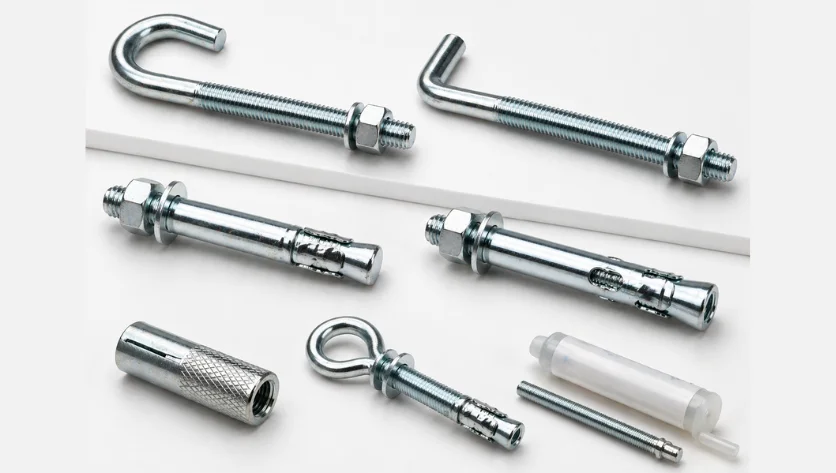
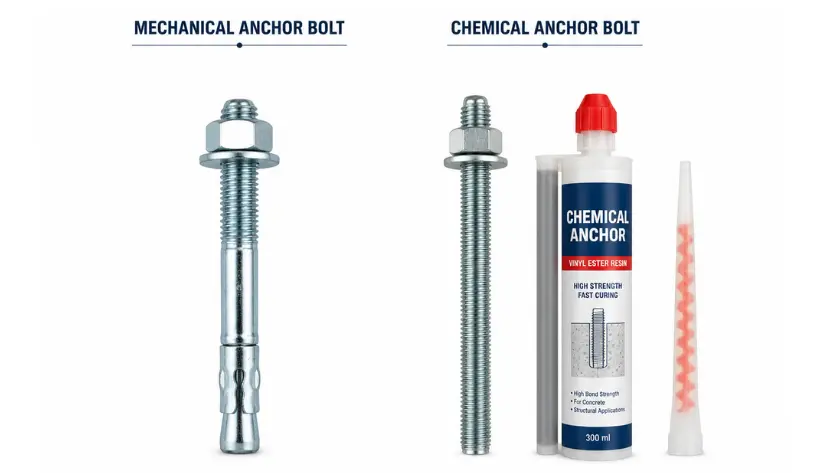
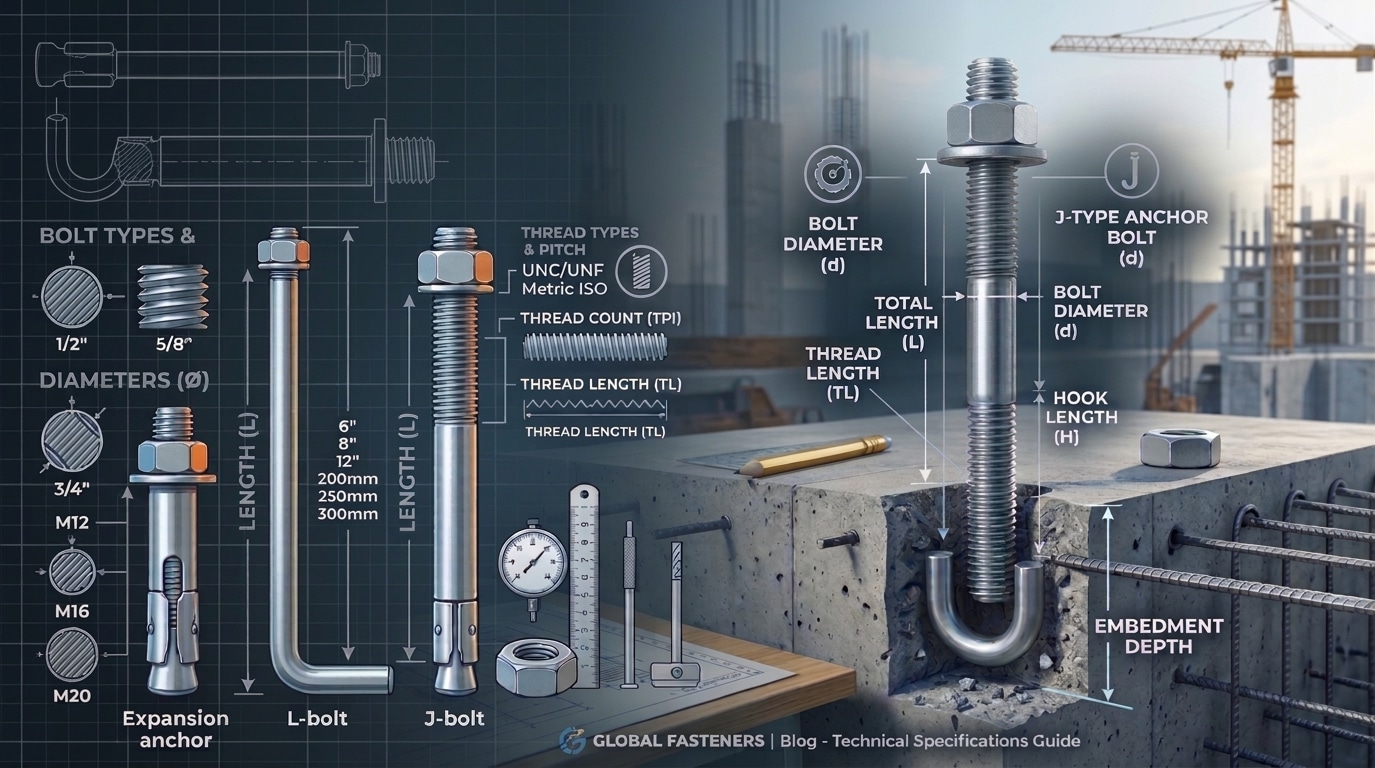
Anchor Bolt Sizes: Diameter, Length, and Thread Specifications Request a Quote Anchor bolt sizes look simple on a schedule. In practice, every dimensional parameter directly impacts the rest of the anchor bolt set. A longer projection demands more thread, a higher grade changes the diameter a designer can justify, and a galvanized finish alters the nut. This article works through those dependencies for foundation anchors. Selecting the correct anchor bolt demands a clear understanding of sizing systems, international standards, and surface finishes. We’ve compiled key metric and imperial data to help engineers, site contractors, and buyers evaluate anchor bolt suppliers in UAE with confidence. That said, this resource covers cast-in-place structural anchors only; chemical capsules and expansion wedge anchors in 10 mm, 12 mm, and 16 mm diameters are excluded. Anchor Bolt Size Chart in mm Foundation anchor sizes are not one-size-fits-all. Instead, they cluster into four distinct diameter groups. Standard selection charts typically map precise anchor bolt dimensions in mm directly against project-required length. Look for your required anchor bolt length and diameter below to instantly align your base plate, grout allowance, and embedment depth. Size Group Diameter (mm) Typical Lengths (mm) Common Applications Small (M6 – M12) 6 – 12 50 – 400 Light steelwork and railings Medium (M16 – M30) 16 – 30 120 – 1000 Pipe supports and machinery Large (M36 – M56) 36 – 56 300 – 2000 Heavy frames and towers Industrial (M64 – M100) 64 – 100 600 – 3000+ Skyscrapers and bridge girders Note: These values are for estimation only. Petrofast can manufacture any custom drawing as per the project’s requirement. Selecting a Size Group Small: Handrail posts, light brackets, and secondary steel. Loads are low, and embedment is usually shallow. Medium: Pipe supports and machinery bases sit here. Vibration is the usual concern, which is why double nuts are often specified. Large: Heavy frames and towers, where uplift and overturning determine both bolt count and diameter. Industrial: Long embedment, tight alignment, and thick base plates. A rigid template matters more at this scale than at any other. Imperial Sizes Imperial anchor bolt sizes begin at 1/2 in and stop at 2 in in this range, threaded to the UNC series under ASTM F1554. Each converts to an awkward metric diameter, which matters when a drawing mixes unit systems. Imperial Size Equivalent (mm) UNC Threads per Inch 1/2 in 12.7 13 5/8 in 15.9 11 3/4 in 19.1 10 7/8 in 22.2 9 1 in 25.4 8 1-1/4 in 31.8 7 1-1/2 in 38.1 6 2 in 50.8 4.5 Metric Thread Pitch and Plate Hole Data Size Coarse Pitch (mm) Stress Area (mm²) Clearance Hole (mm) M12 1.75 84.3 14 M16 2.0 157 18 M20 2.5 245 22 M24 3.0 353 26 M30 3.5 561 33 M36 4.0 817 39 Engineers rely on coarse pitch profiles for metric anchor bolts. This geometry achieves two critical goals: maximizing shear resistance and accelerating on-site assembly engagement. Still, drawing boards don’t dictate the field. Although ISO/DIN specifications strictly govern standard clearance holes to accommodate thermal expansion and slight positioning tolerances, actual site conditions invariably produce subtle setting-out variances. Shapes and Their Dimensional Differences The shape determines the dimensions of the drawing. The guide to types of anchor bolts is followed by the dimensional points of selection. L Anchor Bolt: Features a 90° L-shaped bend, with BL1 and R dimensions indicated on the drawing. There is no J depth, as the bend leg is straight. J Anchor Bolt: Features a curved hook with a defined J depth, with SL1 and JID indicated on the drawing. There is no equivalent depth for an L anchor bolt. Straight Anchor Bolt: Has no bend. The embedded end is secured using a nut and washer or an anchor plate. Plate-Welded Anchor Bolt: A steel plate is welded to the embedded end of the bolt to provide anchorage. T Anchor Bolt: Features a T-shaped head in place of a bent end to provide anchorage within the concrete. Anchor Bolt Length And Thread Length There is no standard rule for the length of anchor bolt threads. The project requirements and the bolt set are defined by the product’s custom drawing. However, the basic logic for calculating anchor bolt length remains similar: Projection: Grout height + Base plate height + Washer height + Nut height + Allowance. Allowance (Estimated): 25 mm to 50 mm to accommodate levelling requirements. Straight Length: Embedment depth + Projection. Worked example, M20. The straight length is approximately 550 mm, based on a grout height of 30 mm, base plate thickness of 25 mm, washer thickness of 3 mm, nut height of 18 mm, and an embedment depth of 450 mm. If the anchor bolt has a bend leg, its dimensions are shown separately on the drawing. The embedment depth is not a catalogue value. It depends on the tension and shear forces acting on the connection, the concrete strength, the edge distance, and the spacing between adjacent anchor bolts. Estimated Weight Of Straight Shank Anchor Bolts (kg) Weight per piece is used for freight planning and quantity checks. The approximate weight of a carbon steel anchor bolt can be calculated using the formula d² × L × 6.17 × 10⁻⁶ (kg), where d is the diameter and L is the length of the steel, both measured in millimetres. Austenitic stainless steel is approximately 2% heavier. The figures given below apply to the straight shank only and exclude any bend, nut, or washer. Size Length (mm) Approx. Weight (kg) M12 300 0.27 M16 400 0.63 M20 500 1.23 M24 600 2.13 M30 800 4.44 M36 1000 7.99 Note: The prescribed values are estimations based on insights of our engineers. Exact specifications may vary. Anchor Bolt Grades and Standards Anchor bolt grade determines yield and tensile strength, which in turn influence the diameter required to withstand a given load. Four standards cover most specifications. For more details on material selection, refer to our guide on anchor bolt grades