Home » Stud Bolts for Oil and Gas | ASTM A193, B7, B8M & Duplex Grades
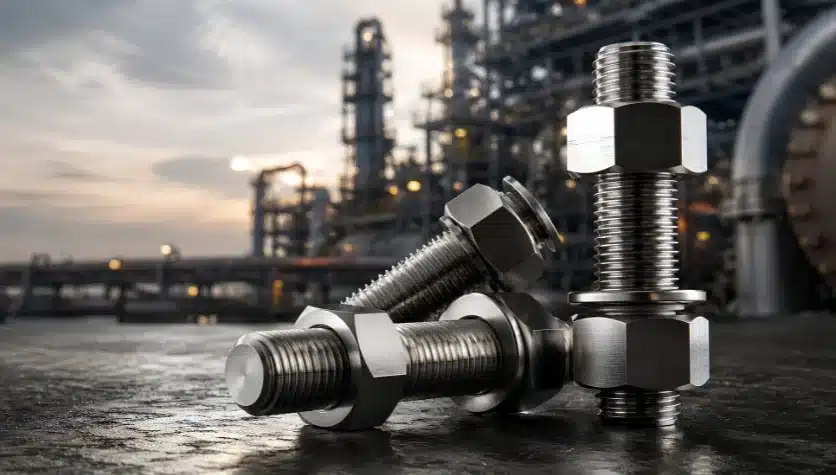
Stud bolts are the primary bolting component in flanged piping systems. In oil and gas service, they must maintain clamping force across a gasket under sustained operating pressure, thermal cycling, and exposure to corrosive media such as H₂S, CO₂, and chlorides.
Loss of preload or premature corrosion of a stud bolt fastener can lead to flange leakage, process shutdown, and a potential safety event in sour gas systems. This article discusses the major ASTM stud bolts specifications, material grades, mechanical property data, coating options and selection criteria.
Flanged joints in oil and gas systems operate at pressure classes ranging from ANSI 150 lb to 2500 lb, with varying design pressures and temperatures across the process. In these joints, industrial stud bolts are used instead of headed bolts as the latter permit the nut to be torqued from both ends, leading to a uniform clamp load on the gasket face and no bending stress on the bolt shank.
The full-length threaded design allows for the removal and replacement of studs without disturbing the pipe. This is important for high integrity systems such as heat exchangers, pressure vessels and wellhead assemblies. In flange pressure classes above 900 lb, gasket seating stress requirements demand a precise and repeatable bolt load, which only correctly specified oil and gas stud bolts UAE can reliably deliver.
High tensile stud bolts are specified when the design requires sustained high preload at operating temperature. ASTM A193/A193M and ASTM A320/A320M govern the two primary service categories: elevated temperature and low temperature. The mechanical property requirements from these specifications directly determine bolt sizing and thread engagement calculations.
Mechanical property data from the ASTM A193 technical data sheet:
These heavy duty stud bolts are verified with a Universal Testing Machine in-house, with Charpy impact testing available for low-temperature grades per ASTM A320.
B7 stud bolts are one of the most commonly specified grades in oil and gas, refinery, and petrochemical piping systems. They are manufactured from chromium-molybdenum alloy steel and go through a quench and temper heat treatment process, giving them the strength and reliability required for high-pressure flanged joints.
B7M is a hardness-controlled version of B7, designed for sour service environments where hydrogen sulphide (H₂S) is present. It complies with NACE MR0175 / ISO 15156, making it the right choice for applications where material hardness needs to be kept within specific limits to avoid stress corrosion cracking.
Selecting the correct paired nut is just as important as the stud itself. ASTM A194 Grade 2H or Grade 7 is used with B7 for standard service, while Grade 2HM or Grade 7M is the correct match for B7M in sour service applications.
Petrofast Middle East FZC supplies B7 stud bolts across a wide range of sizes with surface coating options including PTFE in multiple colours, Hot Dip Galvanized (HDG), Electro Zinc Plated, Yellow Passivated, Black Oxide, Phosphate, Electroless Nickel Plated (ENP), and Zinc-Nickel, all processed in-house at our facility.
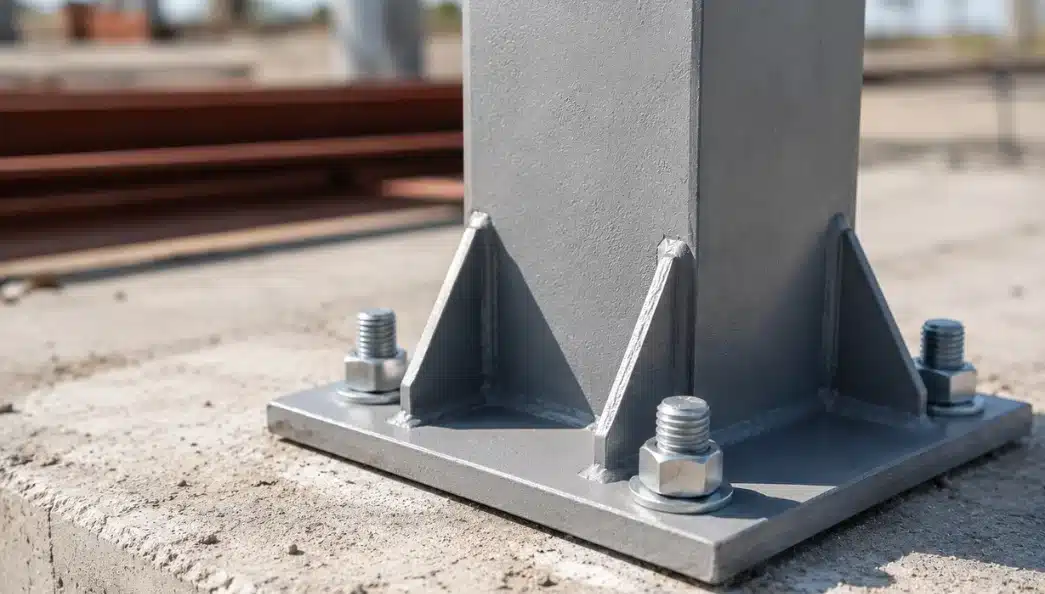
Flange stud bolts connect two flanged pipe ends by passing through aligned bolt holes and being torqued with heavy hex nuts on both ends. The gasket between the flanges deforms under this load, creating a pressure-tight seal. The stud bolt must maintain this seating stress throughout thermal cycling and pressure fluctuation across the pipe service life.
Stud bolt dimensions, including diameter, length, and thread engagement, are determined entirely by the customer’s project specifications, flange rating, and piping design requirements. Petrofast Middle East FZC manufactures stud bolts to any required dimension across all standard and special configurations. Contact our team with your project details for accurate sizing and supply.
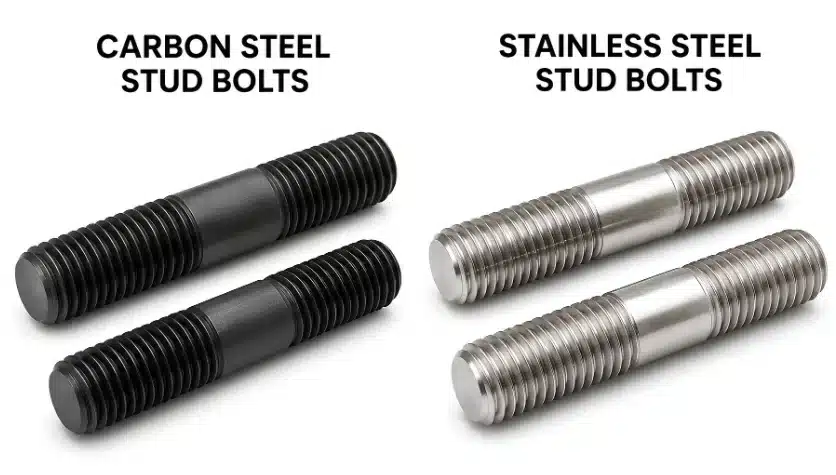
Choosing the right corrosion resistant stud bolts is very important. It depends on how hot it gets, how much pressure there is, and what kinds of liquids or chemicals are nearby. Here are the main types of metals used to make these strong bolts:
You can get these bolts with many coatings: PTFE (in many colors), hot-dip zinc, shiny zinc, yellow coating, black oxide, phosphate, nickel plating, and zinc-nickel. An indoor coating shop ensures these layers are put on perfectly for stainless steel bolts and other alloy types.
Proper selection of threaded stud bolts involves matching the bolt specification to the service conditions. Here is a step by step guide based on catalogue technical parameters.
For specification assistance, visit our stud bolt product page.

A flange leak in an oil and gas plant is never just a maintenance event. It is a process shutdown, a safety incident, and in many cases, a regulatory notification. In the majority of cases, the root cause is a fastener that was under-specified, incorrectly paired with its nut, or procured without verified material certification.
The mechanical property data, hardness limits, chemical compositions, and flange class correlations in this guide exist precisely to help engineers eliminate that risk at the specification stage. Heavy duty stud bolts UAE supplied by Petrofast Middle East FZC carry an MTR (Material Test Report), dimensional inspection record, and material heat traceability because a bolt without documentation is a liability, not a certified component.
We manufacture and stock stud bolts for oil and gas in ASTM A193, A320, A194, A276/A276M, F3125, F436, F959M, F1554, A307, A36, BS EN 14399, ISO 3506 and ISO 898. Available in alloy steel, stainless steel, duplex, super duplex and nickel alloy grades with in-house PTFE
coating, shot blasting, heat treatment and PMI testing all under one roof.
Whether you are specifying flange stud bolts for a new offshore platform or sourcing high tensile stud bolts Dubai for a plant turnaround, you can get the right grade, certified documentation and fast delivery from a single source.
Don’t delay sourcing and get a fast, accurate quote from our experienced team today.
The ASTM A193 Grade B7 bolt is used more than any other. It is very strong and works perfectly in hot, high-pressure places like oil refineries, pipelines, and chemical plants all over the world.
The main difference is how hard they are. B7M bolts are softer than regular B7 bolts. This softness keeps them from cracking when they are around dangerous hydrogen sulfide gas.
Standard stainless steel (like B8M) does okay in salty water. However, for deep ocean work, tougher metals like duplex or super duplex are much better choices because they stop rust for a very long time.
Bolts can be covered in many ways to protect them. Options include PTFE plastic (in different colors), hot zinc baths, shiny zinc plating, yellow coating, black oxide, phosphate, and nickel plating.
Yes. We can provide full test papers, metal checks, safety tests, and official laboratory certificates to prove the bolts meet all the rules for your project.