Home » Anchor Bolts for UAE Oil & Gas Projects | ISO Certified
Every project manager in the UAE knows that feeling. The structure is ready, and all the equipment is in place. And then someone raises a question about the anchor bolts. Are they the right grade? Do they meet the specified standard? Are they tested? In critical industrial environments such as petrochemical complexes, water purification plants, and major building sites, an incorrect response to any of these inquiries can halt a whole undertaking. Petrofast Middle East FZC, situated in Sharjah, UAE, fabricates and delivers a comprehensive selection of finely crafted anchor fasteners designed to adhere to global benchmarks and your precise project specifications.
Anchor bolts are threaded metal fasteners used to affix structural elements to concrete bases. They transmit forces from structures made of steel, equipment, tanks, upright supports, and pressurized containers down to the foundation. If structural anchor bolts are not correctly chosen and installed, entire buildings might collapse when subjected to weight, shaking, or external pressures.
In industrial undertakings throughout the UAE, where the surroundings involve intense heat, salty air, and substantial weights, the caliber and material standard of the high tensile anchor bolts are crucial in dictating the safe service life of a structure.
We manufacture and supply all principal categories of foundation fasteners and expansion anchors utilized throughout building, chemical, maritime, and infrastructure developments. Each design fulfills a distinct structural requirement, and choosing an inappropriate one is a hazard no professional engineer should overlook.
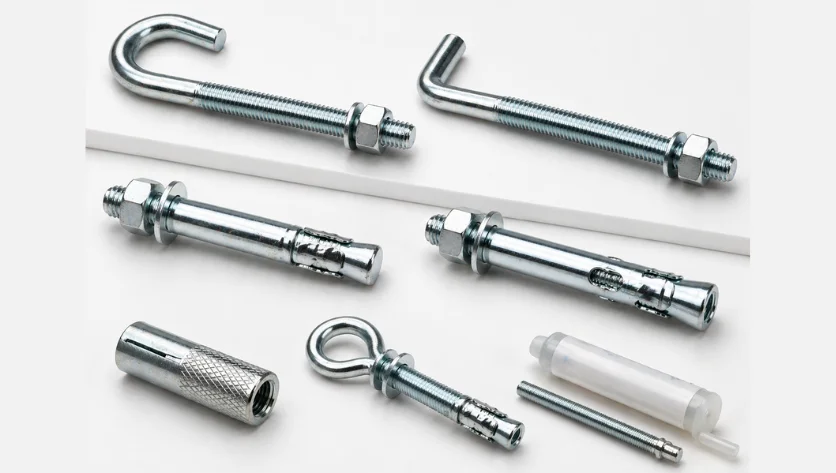
These represent the most widely used style for fastening bottom plates to concrete footings. Plain anchor bolts are embedded in fresh concrete prior to hardening and deliver a straightforward, dependable bond for column supports, equipment, and steel frameworks.
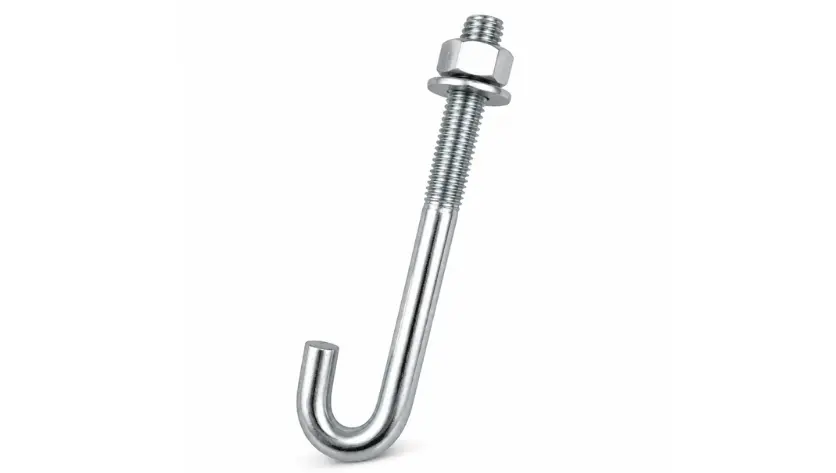
The L-type and J-bolt variants are cast into concrete foundations with a bent end that provides mechanical resistance against pull-out forces. J-bolt anchors are widely used for pipe supports, light towers, and secondary structural connections. The L-shaped anchor bolts are preferred where higher tensile loads are present, such as column base plates in steel structures.
These designs are employed when an added retention force is needed. A washer, plate, or cuff is fused to the buried section of the fastener prior to concrete setting. This considerably boosts the load-carrying capability of the anchor bolts in uses such as substantial equipment foundations and container cradles.
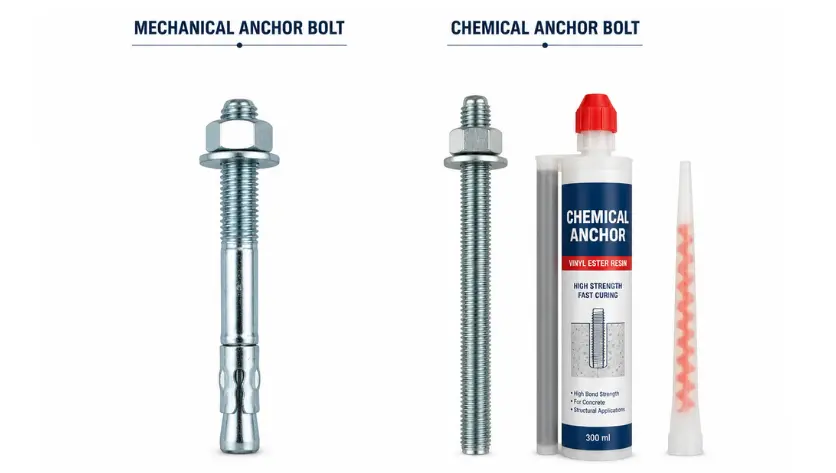
Chemical anchoring rods, also known as resin anchors, utilize a dual-component adhesive mixture injected into a previously bored opening to secure the rod within hardened concrete. This style sees widespread application in renovation and fixing tasks throughout the UAE’s construction endeavors. Petrofast Middle East manufactures and supplies these chemical anchors in standard carbon steel and stainless steel to meet varying resistances to rust and load specifications.
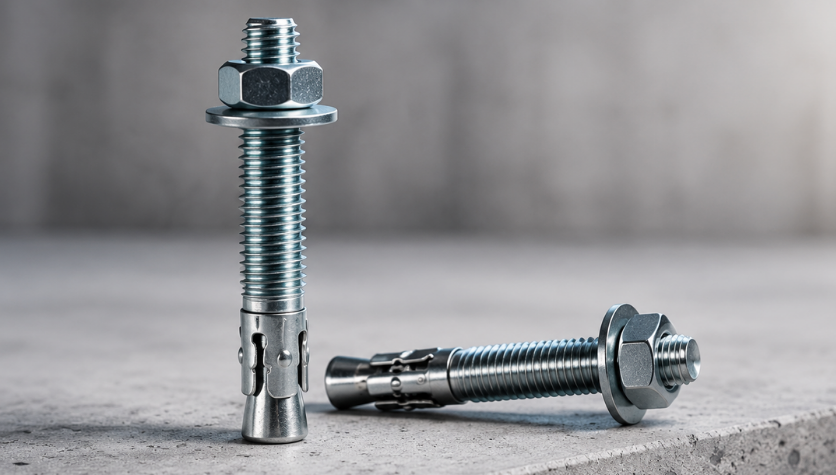
The wedge anchor bolt functions by expanding within a bored opening as the securing nut is tightened. This makes it among the quickest methods for affixing steel to established concrete. Through-fasteners extend entirely through the concrete or base material and are secured from opposing faces. Both styles see extensive use throughout GCC construction and industrial upkeep endeavors.
The sleeve-type expansion fastener utilizes an exterior casing that spreads outward against the concrete surface inside a bored opening as the bolt is forcibly inserted. This action establishes a secure, shake-resistant fastening appropriate for lighter to moderate structural stresses.
Drop-in anchors are internally threaded expansion anchors set flush with the concrete surface. They are used for suspended ceilings, equipment hangers, and light structural connections where the anchor must be hidden below the surface level.
The following chart outlines the primary anchor bolt designs available from Petrofast Middle East, detailing their relevant specifications, material strengths, surface treatments, and typical functions within the UAE’s industrial and building sectors.
|
Type
|
Standard
|
Grade
|
Application
|
|---|---|---|---|
|
Straight Bolt
|
EN10025-2 / ASTM F1554
|
S275JR, S355JR, Gr.36, Gr.55, Gr.105
|
Equipment bases, machinery
|
|
L-Type (L-Bolt)
|
ASTM F1554 / ISO 898-1
|
Gr.36, Gr.55, Gr. 105 CL 4.6, 8.8
|
Column bases, steel structures
|
|
J-Bolt
|
ASTM F1554 / EN10025-2
|
Gr.36, Gr.55, Gr.105 / S275JR, S355JR
|
Pipe supports, light structures
|
|
Nut & Plate Welded
|
ASTM F1554 / ASTM A276
|
Gr. 36, Gr.55, Gr.105 /SS304/SS316
|
Heavy structural anchoring
|
|
Chemical Anchor Bolt
|
ASTM A276
|
SS304, SS316,
|
Retrofits, concrete anchoring
|
|
Wedge Anchor
|
ASTM A276
|
SS304, SS316,
|
Concrete, masonry structures
|
|
Sleeve Expansion
|
ASTM A276
|
SS304, SS316,
|
Hollow concrete, masonry
|
To view the entire selection of grades, surface treatments, and arrangements, look through the full product listing found here to pinpoint precisely what your undertaking requires.
Whether you are sourcing anchor bolts for construction UAE projects or for a major oil and gas facility, we have you covered. Every product from our unit is manufactured in full compliance with the international specifications listed below.
For a full reference to ASTM F1554 standard specifications, you can visit the official ASTM International website. For ISO standards used in construction fasteners, refer to the ISO official portal.
The specification for anchor bolt material quality is significant. In harsh settings characterized by corrosion, elevated temperatures, or heavy stresses such as those common within the UAE’s petroleum and gas installations, selecting an improper material class risks fastener breakdown, structural impairment, and expensive operational halts.
Standard carbon steel anchor bolts suit the majority of building and typical industrial uses. They deliver significant pulling power while remaining budget-friendly. For more rigorous structural load demands, alloy steel anchor bolts, like those conforming to ASTM F1554 Grade 105, offer superior robustness. Teams looking for heavy duty anchor bolts Dubai projects requiring large equipment bases and structural frames consistently choose alloy steel for this reason.
Anchor bolts crafted from SS304 and SS316 stainless steel are employed when resistance to corrosion is paramount. Projects in seashores, marine settings, and chemical handling plants within the UAE necessitate SS316 or even better grades for enduring functionality. Petrofast Middle East team additionally manufactures anchor bolts in Duplex S31803 and Super Duplex S32750 for intensely corrosive conditions, delivering enhanced resilience alongside robust mechanical integrity. Demand for chemical anchor bolts UAE-wide has also grown significantly in these same environments, particularly for retrofit and repair work in existing concrete structures.
Anchor bolts treated with hot-dip galvanization are a very common selection in construction and infrastructure projects throughout the UAE. This hot-dip galvanizing method deposits a substantial zinc layer, offering durable defense against oxidation and decay, even in settings that are outdoors or partially shielded. Our expert team handles the galvanizing internally, guaranteeing that the coating’s depth and adhesion meet the standards outlined in ASTM A153 / A123.
For applications where chemical exposure, friction, or thread galling is a concern, our expert and professional team offers anchor bolts with PTFE coatings, Electroless Nickel Plating, Yellow Passivation, and Zinc Nickel coatings. The in-house PTFE coating plant allows us to control coating quality and turnaround time directly.
The anchor bolt diameter and length must match the structural design drawings and the applied load calculations. Engineers specifying foundation anchor bolts UAE projects will find the table below a useful starting reference for commonly used sizes, thread types, coatings, and their typical applications. For teams looking to buy anchor bolts, suppliers like Petrofast Middle East stock the most common sizes from M12 to M48, ready for dispatch. Custom sizes beyond M48 are available on request.
|
Diameter
|
Thread Type
|
Coating / Finish
|
Typical Use
|
|---|---|---|---|
|
M12 (1/2")
|
UNC / Metric
|
Zinc Plated / HDG
|
Light equipment, small frames
|
|
M16 (5/8")
|
UNC / Metric
|
Zinc Plated / HDG / Black
|
Structural steel connections
|
|
M20 (3/4")
|
UNC / Metric
|
HDG / Black / PTFE
|
Column base plates, machinery
|
|
M24 (1")
|
UNC / Metric
|
HDG / Black / ENP
|
Heavy machinery, tanks
|
|
M30 (1-1/8")
|
UNC / Metric
|
HDG / Black
|
Platform structures, towers
|
|
M36 (1-3/8")
|
UNC / Metric
|
HDG / Black / Bright
|
Pressure vessels, large columns
|
|
M42 (1-1/2")
|
UNC / Metric
|
HDG / Black
|
Heavy industrial, offshore
|
|
M48 and above
|
UNC / UNF / Metric
|
Any per requirement
|
Subsea, nuclear, desalination
|
Petrofast Middle East FZC operates under an ISO 9001:2015 certified Quality Management System. This means every batch of anchor bolts we manufacture or supply goes through defined inspection steps before it reaches the customer.
All fasteners are verified for chemical composition, mechanical properties, dimensional accuracy, and coating thickness. Advanced testing services include Positive Material Identification for specialty alloys such as Duplex and Super Duplex materials. Non-Destructive Testing methods, including Dye Penetrant testing, are available for project-specific requirements.
Testing is conducted through stringent internal procedures and ISO 17025-approved laboratories. Every product is delivered with complete traceability documentation and test reports as per the relevant international standard specification.
Petrofast Middle East serves a wide range of industrial and construction sectors across Sharjah, Dubai, Abu Dhabi, and the broader GCC region. The demand for industrial anchor bolts Dubai alone spans everything from high-rise structural steel to major refinery expansion projects. Anchor bolts from our factory are actively used in the following applications.

Procurement teams working across these sectors have consistently relied on our dependable services to deliver certified, traceable fasteners on schedule. If your sector is listed above, explore what we supply for your industry and see how we have supported projects like yours.
Petrofast Middle East FZC boasts over two decades of expertise as a manufacturer and supplier of fasteners within the GCC area. Their production plant covers 10,000 square meters and is outfitted with all the necessary machinery for operations such as cutting, threading, shaping, tapping, joining, marking, thermal processing, abrasive blasting, and PTFE application, all managed internally.
This vertical integration means we control every stage of production from raw material to the finished product. This gives customers full confidence in delivery schedules, quality consistency, and competitive pricing. Projects requiring custom anchor bolt designs from client drawings are accepted and handled with the same quality standards applied to standard products.
Our team also maintains a network of companies across the UAE, UK, USA, and Pakistan, all operating under the Petrofast Group of Companies. For procurement teams requiring an anchor bolt supplier UAE with a proven global track record.
For your industrial anchor bolt needs in Dubai, Sharjah, or throughout the GCC, our unit offers the stock, production capacity, and technical know-how to assist from initial query through to shipment. Whether you require large quantities of common dimensions or entirely bespoke foundation anchor bolts made from your blueprints, our personnel are prepared to help. Submit your specifications directly here, and our staff will respond with details on configuration, turnaround times, and costs. Should you prefer to confirm material grades and designs beforehand, the complete technical catalogue can be downloaded for your engineering department’s review prior to order placement.
A chemical anchor bolt uses strong glue to stick to concrete. A mechanical anchor bolt grows wider to grip the hole. Glue works better in cracked floors, but mechanical types are faster.
Most oil jobs use ASTM F1554 Grade 55 or 105. For rust safety, they use stainless steel or Duplex. Always check with your project engineer to pick the right metal grade.
Yes, we can manufacture custom anchor bolts using your drawings. We handle the cutting, bending, and welding in our shop. Every bolt comes with papers that prove it is safe.
We deliver anchor bolts from M12 up to M48 sizes. If you need something bigger than M48, we can produce it for you. We manufacture these special sizes to fit your plan.
We deliver coatings like hot-dip galvanised, zinc, and PTFE. These layers stop rust. The best coating depends on the heat and if the bolt is near the salty sea air.