A Technical Guide to Fastener Coating Options for Wear Resistance & Longevity
Coating choices for any fastener significantly impact its performance and durability. However, many people overlook the importance of choosing the right coating. For example, you may find it challenging to select the best fastener coating at first. In fact, materials like zinc, nickel, chromium, and phosphate each offer unique benefits in the right situations.
To begin with, you should consider your operating environment to get the right alternative for your needs. Additionally, you should carefully consider the overall performance requirements of your fasteners to decide which coating option will best suit your specifications. For instance, corrosion resistance, durability, torque, and temperature are all significant concerns in coating alternatives.
In this article, we’ll explore the numerous coating and plating choices for fastening products. As a result, this blog will help you pick the precise one for your requirements.
What is a Fastener Coating?
Manufacturers apply fastener coatings as protective layers to screws, bolts, and other fastening components. These coatings improve durability, enhance performance, and increase corrosion resistance. They also protect the base metal from chemicals, moisture, and temperature fluctuations. The right coating maintains structural integrity and significantly extends the lifespan of fasteners in many applications.
Different Coating Options for Fasteners in Industrial Applications
Electroplated Zinc Coating
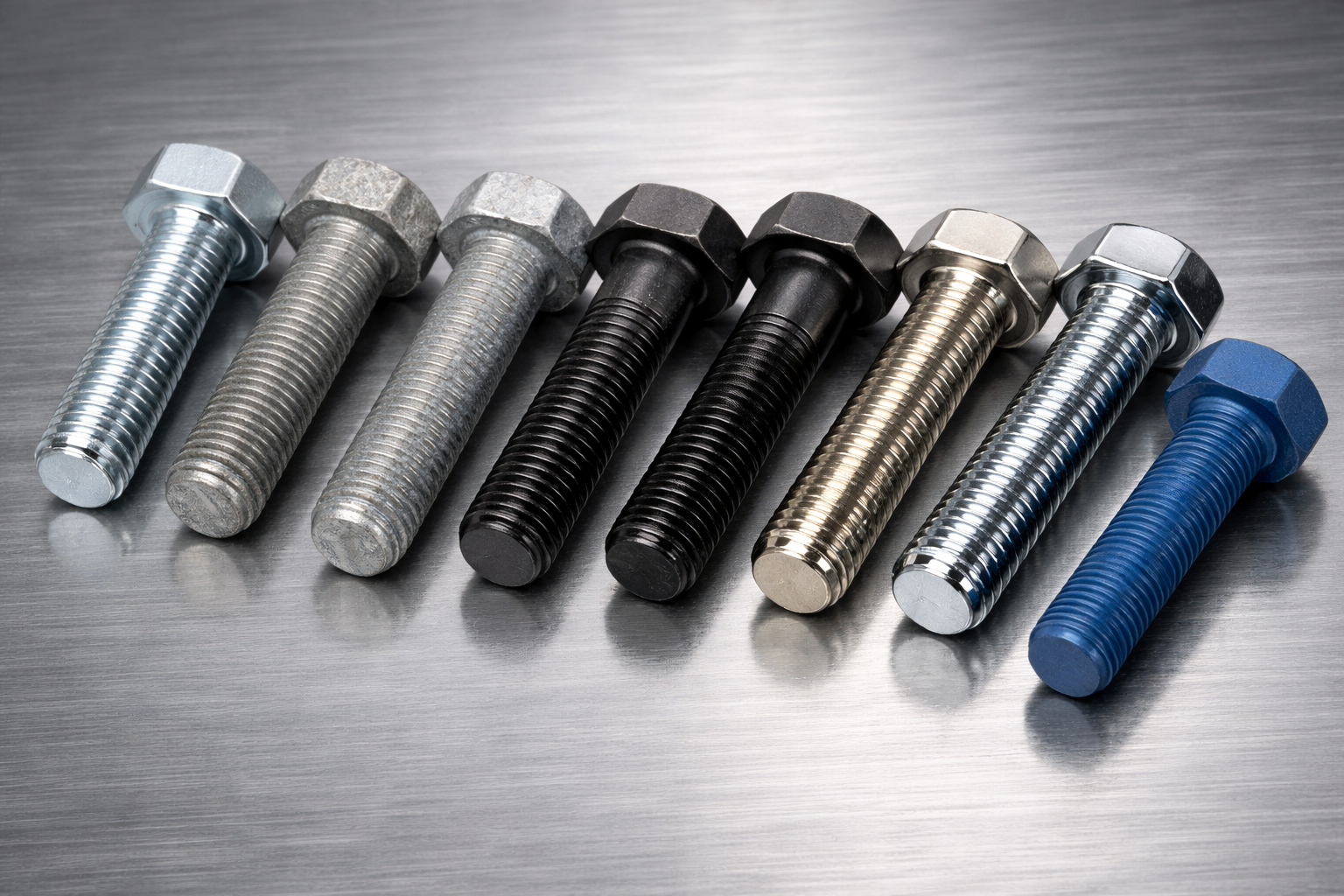
Electrogalvanized fasteners contain a thin zinc layer that provides basic corrosion resistance. Many manufacturers use this coating for interior applications such as bathroom and kitchen panels where minimal protection is sufficient.
Manufacturers apply the zinc layer through a controlled electrochemical process that ensures uniform coverage and consistent thickness. This precision helps electrogalvanized fasteners maintain accurate dimensions and a smooth surface finish while offering moderate corrosion protection. Builders also use them in roofing and construction projects where the environment is not extremely harsh.
Hot-Dip Galvanizing (HDG)
Hot-dipped galvanized coatings provide a thicker layer of zinc at the fastener’s surface than a fashionable zinc plating would. Hot dipped galvanizing coatings are better at resisting corrosion for this reason. Also referred to as HDG, this kind of coating is good for fasteners with the view to be used outdoors. It’s ideal for coastal areas with high salt exposure with its guaranteed corrosion resistance.
HDG covered fasteners will withstand corrosion plenty longer than products with other coatings. The thickness guarantees sturdiness in harsh conditions, even though it is able to barely have an effect on the threading and precision of the fastener.
Mechanical Galvanizing
Mechanical plating is a surface finishing method that entails applying a protective zinc coating to fasteners for better corrosion resistance. Fasteners are placed in a revolving drum with water, glass beads, zinc powder, and specialist chemical components. The continuous tumble generates a regulated abrasive environment on the fastening floor.
This mechanical action enables a cold welding mechanism, enabling zinc particles to attach directly to the fastener surface without the use of an electrical cutting machine. The zinc oxide is evenly distributed over the components, as per the process. The robust finish enhances the fasteners’ performance and resiliency.
Zinc Coating
Zinc may be applied to aluminum alloys, brass, bronze, copper, iron, steel, and many different commonly used alloys using an electroplating technique. The electroplating technique causes the zinc to oxidize in a thin, tightly adhered layer; this is referred to as zinc oxide.
Zinc oxide plating is a good alternative for small fasteners, which can be used within indoor environments or minimally in deep outdoor applications.The zinc-plated fasteners appear to have a dazzling silver grey appearance.
Black Oxide Coating
Black oxide coating is a mild plating alternative that gives fundamental safety from corrosion and abrasion. It may be oiled or waxed for added protection to gain more corrosion resistance. Since black oxide prevents rust, it’s far more typically used on fasteners with a purpose to be established in outdoor environments.
The most unusual metallic substrate for this form of coating is metal, but chrome steel fasteners are sometimes extensively utilized. Unlike with galvanized coatings, black oxide does not exchange the fasteners’ dimensions. This makes it a super desire for near tolerance machined elements.
Phosphate Coating (Black / Zinc Phosphate)
Phosphate coatings create a thin crystalline layer on the fastener surface. Manufacturers commonly use this coating as a base layer before applying additional finishing treatments.
This treatment improves adhesion for paints, sealants, and other protective coatings. It also increases wear resistance and helps components withstand mechanical stress. During assembly, phosphate coatings reduce friction and help installers position fasteners more easily. On its own, the coating provides limited corrosion protection but serves as an excellent base for additional finishing layers.
Nickel Plating
Nickel plating gives fasteners a bright and attractive finish while improving corrosion and wear resistance. Many industries use this coating for components that require moderate protection and decorative appeal, including automotive trim parts.
The nickel layer also increases surface hardness, which improves performance in applications involving movement or friction. Although nickel plating costs more than standard zinc coatings, it provides excellent durability and consistent performance. However, engineers avoid using nickel plating in nitrogen-rich environments.
Chrome Plating
Chrome plating creates a tough electroplated layer that enhances surface hardness and wear resistance. The process forms a dense, smooth finish that increases durability and extends fastener service life.
Chrome-plated fasteners resist friction, mechanical stress, and mild corrosion while maintaining a low-friction surface. Automotive and precision engineering industries often use chrome plating where durability and reliability are essential.
PTFE / Xylan Coating
PTFE (Xylan) coatings act as high-performance dry lubricants for fasteners. They reduce friction and improve wear resistance during assembly. The smooth low-friction surface simplifies installation and lowers torque requirements.
These coatings also resist chemicals and extreme temperatures, which makes them suitable for industrial and aerospace applications. Since PTFE alone offers limited corrosion protection, manufacturers often combine it with other coatings to improve durability while preserving dimensional accuracy.
Wrapping Up!
Petrofast Middle East provides a comprehensive range of high-performance fasteners with precision-engineered coatings for commercial projects. Our portfolio includes zinc, nickel, phosphate, and stainless-steel finishes that improve corrosion resistance and mechanical durability. We also maintain a premium stock of heavy-duty fasteners that meet strict engineering specifications.
If you need more information or want to purchase fastening components with high-quality coatings at competitive prices, contact Petrofast Middle East today.
FAQs
Are zinc screws rustproof?
Zinc screws resist rust but are not completely rust-proof. They perform properly in humid areas, but prolonged exposure to saltwater or severe conditions may result in deterioration over time.
Are zinc bolts right for outdoor use?
Yes, a zinc bolt works well outdoors, particularly in coastal areas. Warm-dip galvanized or chrome steel fasteners are ideal for tougher situations and provide better long-term durability
Which is better, black oxide vs. zinc-plated?
Black oxide is appropriate for aesthetics and interior finishings. Moreover, zinc plating offers superior corrosion resistance, making it preferred for outdoor applications.