Home » Anchor Bolt Material Guide: Types, Grades & Standards
When you are building a pipeline support in Sharjah, installing heavy machinery in an Abu Dhabi refinery, or setting up a steel structure at a construction site across the GCC, the bolts that hold everything to the ground matter more than most people think. The wrong choice can lead to loosening, corrosion, or structural failure. The right choice keeps your project safe for decades. This guide walks you through every major anchor bolt type used in industrial and construction projects today, with technical details sourced from international standards, so you can make an informed decision every time.
An anchor bolt is a fastener designed to connect structural or non-structural elements to concrete or masonry. Unlike a standard hex bolt that connects two metal parts, an anchor bolt is embedded into or drilled into a base material, with one end projecting out to accept a nut, plate, or fixture. They are used in almost every industrial sector, from oil and gas and petrochemical plants to bridges, towers, and commercial buildings. In the UAE and broader GCC region, where construction activity is intense and environmental conditions are harsh, selecting the correct anchor bolts for construction is a critical engineering decision.
At Petrofast Middle East FZC, we manufacture and supply a comprehensive range of structural anchor bolts and foundation anchor bolts to clients across the GCC, following international standards such as ASTM F1554, ISO 898-1, and EN 10025-2.
Not all anchor bolts are the same. The type you choose depends on the base material, load requirements, environmental conditions, and whether installation happens before or after the concrete is poured. Below is a detailed breakdown of each major type.
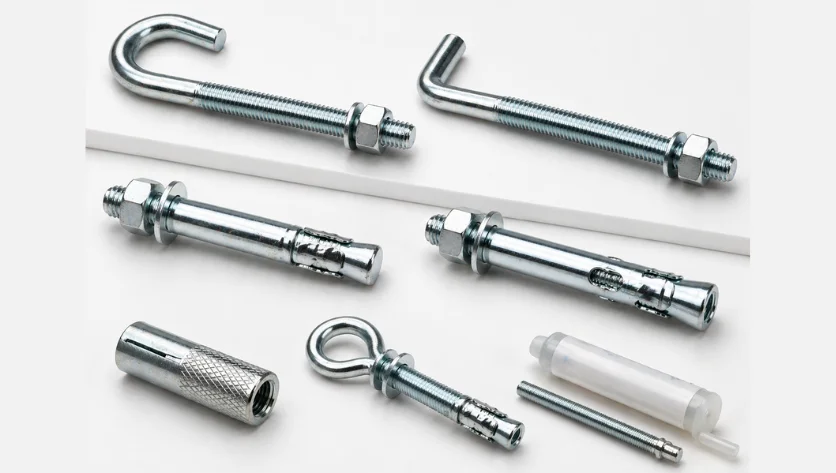
The L-shaped anchor bolt is one of the most widely used foundation anchor bolts in industrial construction. Its L-shaped bend is embedded into wet concrete before it sets, and the threaded end projects above the surface to accept nuts and washers. The bend prevents pull-out forces from dislodging the bolt, which makes it ideal for attaching column base plates, machine frames, and equipment pedestals to reinforced concrete foundations.
Petrofast supplies L-shaped anchor bolts for oil and gas and heavy industrial applications as per ASTM F1554 grades 36, 55, and 105. These are available with Hot Dip Galvanised (HDG) or plain black finish. Stainless steel anchor bolts in grades SS304, SS304L, SS316, and SS316L are also available for corrosive environments.
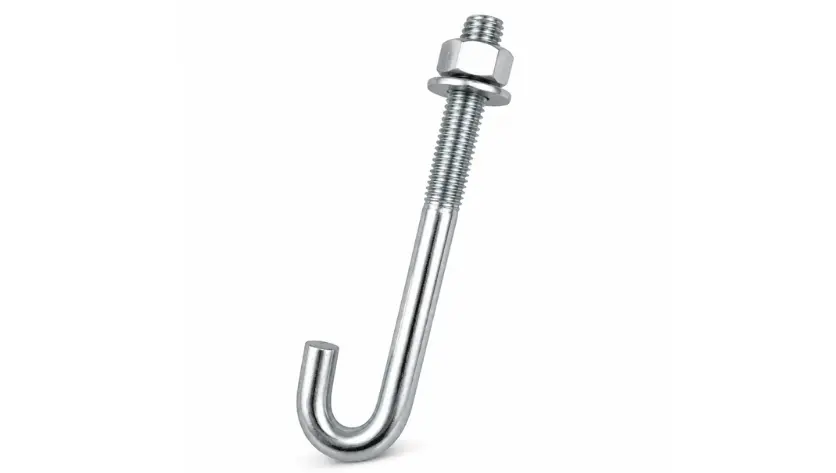
The J-bolt anchor looks exactly like its name suggests: a hook shaped like the letter J at the bottom. This shape provides extra pull-out resistance by hooking into the cured concrete. J-bolt anchors are typically used for lighter structural applications such as light poles, sign posts, pre-engineered steel buildings, and smaller equipment bases. They are also a popular choice for anchor bolts for construction of mid-rise buildings and utility installations across the UAE.
Like the L-bolt, J-bolt anchors are installed in wet concrete before it cures. The hook end locks into the concrete, while the threaded end accepts a standard hex nut and flat washer. Petrofast manufactures J-bolts per ASTM F1554 and ISO 898-1, with grades and finishes matching client project specifications.
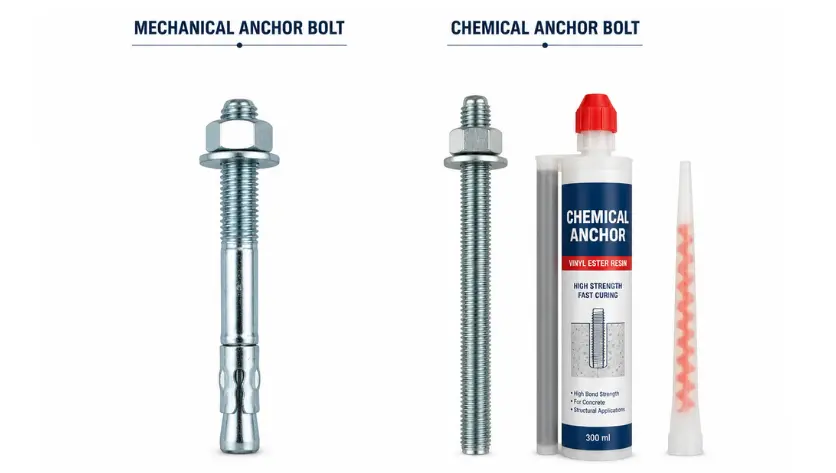
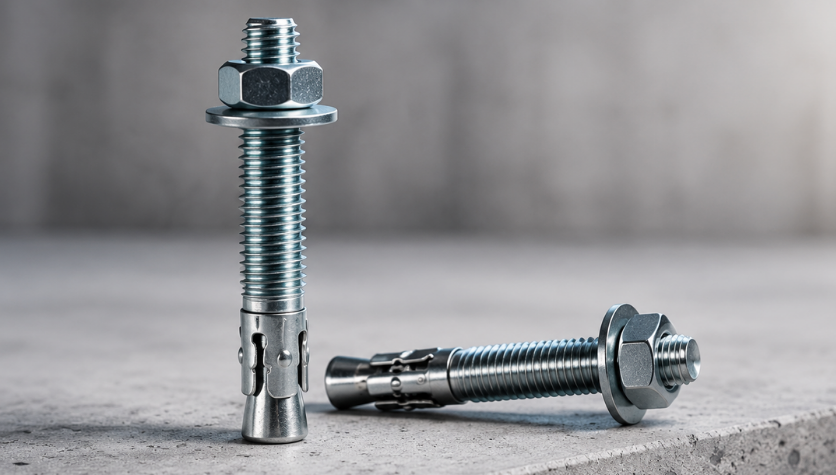
When you cannot install bolts before the concrete is poured, wedge anchor bolts are the go-to solution. A wedge anchor bolt is drilled into hardened concrete through a pre-drilled hole. As the nut is tightened, a wedge-shaped clip at the bottom of the bolt expands outward, gripping the sides of the drilled hole from the inside. This mechanical expansion creates a very strong, reliable connection.
Wedge anchors are classified as post-installed expansion anchors and are widely used across the GCC for structural retrofitting, adding machinery supports to existing slabs, and securing racking or shelving systems. Petrofast supplies heavy duty anchor bolts of this type in mild steel and stainless steel 304 and 316, with HDG and Zinc Plated surface finishes, as per ASTM F1554 and ISO 898-1 specifications. View our full product catalogue for available sizes and grades.
For applications that demand the highest load capacity, particularly in cracked or weak concrete, chemical anchor bolts are the correct choice. Instead of mechanical expansion, a chemical anchor bolt uses a two-component resin or adhesive injected into a pre-drilled hole. The anchor rod or threaded bar is then inserted into the resin-filled hole, and the chemical compound cures to create an extremely strong, monolithic bond between the rod and the concrete.
Because the resin distributes stress over the entire bonded length, chemical anchor bolts do not induce expansion stress in the surrounding concrete. This makes them ideal for use near the edges of concrete elements, in hollow masonry, and in thin concrete sections where a wedge or sleeve anchor might cause cracking. They are also the preferred anchor bolts for oil and gas facilities where vibration loads are present. Petrofast supplies the anchor rods and fully threaded bars used in chemical anchor systems to ASTM A193 and ISO 898-1 standards.
A sleeve expansion anchor bolt consists of a bolt or rod surrounded by a cylindrical metal sleeve. When the nut is tightened, the bolt is drawn upward, forcing the sleeve to expand against the walls of the drilled hole. This type of expansion anchor works well in both solid concrete and hollow block or brick walls, making it one of the most versatile types of concrete anchor bolts available. Petrofast supplies sleeve anchors in mild steel and stainless steel 304 and 316, with HDG and zinc-plated finishes.
Drop-in expansion anchors are internally threaded anchors that are inserted into a pre-drilled hole and then set by driving a setting tool into the top. This expands the lower end of the anchor outward, gripping the concrete. The result is a flush-mounted female anchor point. These are used extensively in overhead concrete applications, such as HVAC supports, pipe hangers, and suspended ceilings. Petrofast stocks drop-in anchors and similar anchor fastener bolt variants in mild steel and stainless steel 304 and 316 for industrial and construction applications across the UAE.
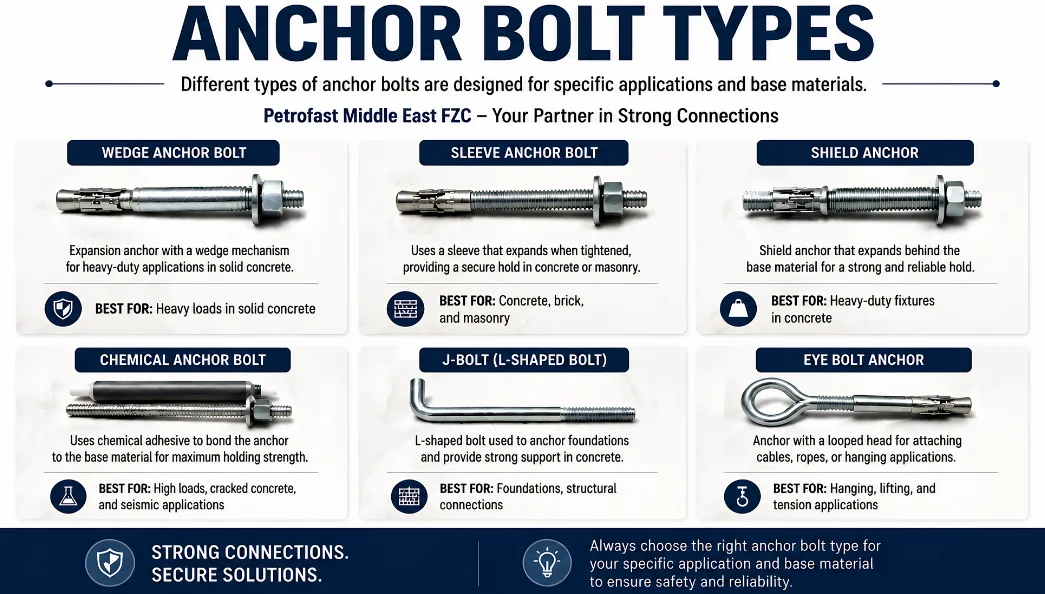
The table below brings together all the key technical details for each anchor bolt type, so you can quickly compare and shortlist the right option for your project.
|
Anchor Bolt Type
|
Best Application
|
Standard
|
Load Capacity
|
Key Feature
|
|---|---|---|---|---|
|
L-Shaped Anchor Bolts
|
Concrete foundations
|
ASTM F1554 / ISO 898-1
|
High
|
Bolt embedded before pour
|
|
J-Bolt Anchors
|
Light machinery, poles
|
ASTM F1554 / ISO 898-1
|
Medium
|
Hook gives extra pull-out strength
|
|
Wedge Anchor Bolts
|
Concrete post-installation
|
ISO 898-1
|
Very High
|
Mechanical expansion in the hole
|
|
Chemical Anchor Bolts
|
Cracked concrete, high load
|
ETAG 001
|
Extremely High
|
Resin bond, no stress on concrete
|
|
Drop-In Anchors
|
Overhead/flush applications
|
ASTM A276, ISO 898-1
|
High
|
Internal expansion mechanism
|
|
Hollow / Blind Bolts
|
Hollow steel sections
|
ASTM F3125
|
High
|
One-sided installation only
|
Different sectors require different anchor bolt solutions. Here is how the main sectors in the UAE and GCC match up with the most suitable anchor bolt types based on Petrofast’s project experience and product range.
In refineries, process plants, and offshore platforms, industrial anchor bolts must handle vibration, high temperatures, and aggressive corrosive environments. Stainless steel anchor bolts in SS316L, along with high-strength alloy grades per ASTM A193 B7 and B8M, are standard. Chemical anchor bolts and PTFE-coated structural anchor bolts are also heavily used for their corrosion resistance and high load performance. Our anchor bolt products cover this entire spectrum.
For commercial buildings, warehouses, and civil structures across the UAE, L-shaped anchor bolts and J-bolt anchors for wet concrete, along with wedge anchor bolts for existing slabs, cover most needs. These heavy duty anchor bolts UAE are supplied with HDG coating to resist the humid Gulf environment.
Bridge supports, marine jetties, and port infrastructure require foundation anchor bolts UAE built to withstand saltwater exposure and heavy cyclic loading. Duplex stainless steel grades S32205 and S32750 provide the best combination of strength and corrosion resistance for these environments.
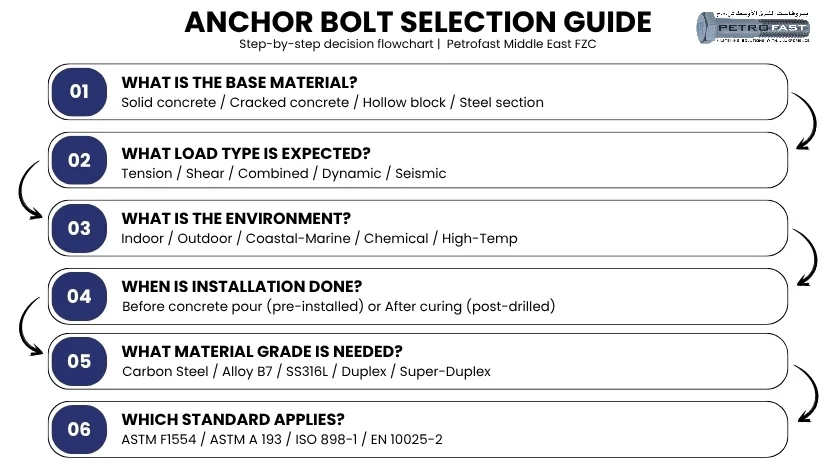
Choosing the correct anchor bolt does not have to be complicated. Follow these six steps, illustrated in the diagram below, to narrow down the best type for your specific application.
First, look at what the bolt is going into. Petrofast makes bolts for different surfaces. If you are anchoring into solid concrete, you need heavy structural bolts. If you are working with brick or masonry blocks, you will need versatile stud bolts or threaded bars. The surface type determines the shape of the bolt you should choose.
Next, think about how much weight the bolt must hold. Petrofast uses strong international steel grades to handle heavy loads:
The air around your project matters a lot. If your bolt is outside, it needs a protective coating so it does not rust. Petrofast offers special finishes to protect the metal:
Is your project in a very hot or freezing cold place? Regular steel can crack if it gets too cold.
An anchor bolt cannot do its job alone. It needs a matching nut to lock everything in place. To prevent the threads from stripping, you must match the strength of the nut to the bolt. For example, if you use a high-strength Petrofast bolt, always pair it with a heavy hex nut built to ASTM A194 or DIN 934 standards.
Selecting the correct anchor bolt types is not just a technical exercise. It is the foundation of every safe, long-lasting structure. Whether you need L-shaped anchor bolts and J-bolt anchors for new foundations, wedge anchor bolts for post-installed concrete fixing, chemical anchor bolts for cracked or high-load zones, sleeve anchors for hollow sections, or specialty stainless steel anchor bolts and duplex anchor bolts for harsh offshore and chemical environments, Petrofast Middle East FZC has the stock, the manufacturing capability, and the technical expertise to deliver the right solution.
Every bolt we supply is tested for chemical composition, mechanical properties, dimensional accuracy, and coating thickness, and comes with full traceability and test reports per international standards. With over 20 years of experience serving the GCC’s oil and gas, construction, and industrial sectors, we understand what industrial anchor bolts, structural anchor bolts Dubai, and construction anchor bolts UAE projects truly demand.
Ready to source anchor bolts you can rely on? Contact our technical team today to discuss your project requirements, get a quote, or request a material test report. Let Petrofast be your trusted fastening partner because the strength of your structure starts at the anchor point.
L-shaped and J-bolt anchor bolts are most common for foundations, while wedge anchors are widely used for post-installed concrete applications in UAE construction projects.
Mechanical anchors expand physically inside the hole to grip. Chemical anchors use adhesive resin for bonding, offering higher load capacity, especially in cracked or weak concrete.
Chemical anchor bolts are specifically designed for cracked concrete. They distribute stress through resin, making them the safest choice for structural and oil and gas applications.
Yes. The harsh Gulf climate causes rapid corrosion. Stainless steel anchor bolts, grade 304 or 316, are strongly recommended for coastal, offshore, and chemical industry environments in UAE.
ASTM F1554 is the primary standard for straight and bent foundation anchor bolts. It covers grades 36, 55, and 105, ensuring reliable strength for structural installations.