Stainless Steel vs Carbon Steel Stud Bolts
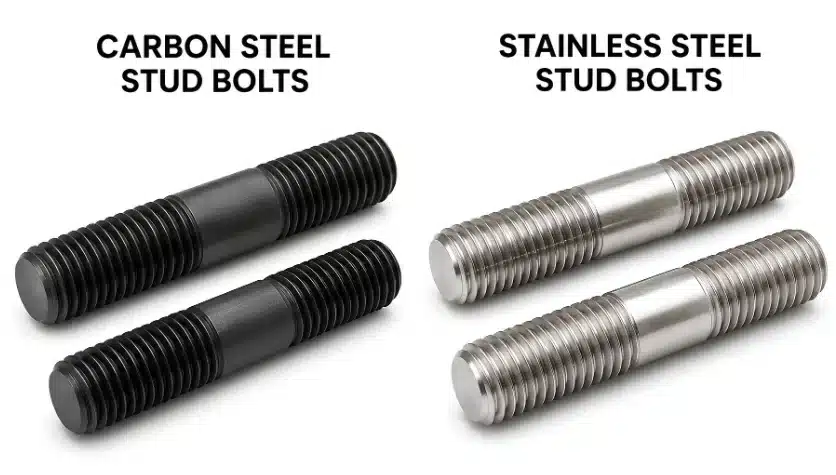
Carbon Steel or Stainless Steel Stud Bolts? What Is Costing Your Project? Request a Quote One of the most expensive mistakes you can make on a big project is using the wrong metal in your bolts. Incorrect bolt choice can result in early failure, whether you’re constructing an oil and gas pipeline in Abu Dhabi or a skyscraper in Dubai. This leads to expensive shutdowns and dangerous safety risks. We will explain the good parts, the bad parts, and how to pick between stainless steel stud bolts and carbon steel. Who We Are: Petrofast Middle East FZC is a trusted bolt manufacturer supplier in the UAE. We make and sell top-quality bolts that meet all international safety rules. What are Stainless Steel Stud Bolts Stainless steel stud bolts are long metal pins that have screw threads on the entire length of one end to the other. They are made from different grades of rugged stainless steel. The coolest thing about these bolts is that they have a metal called chromium. This extra ingredient makes an invisible shield on the surface of the bolt. This shield keeps air and water away from the metal so it doesn’t rust and break. They are corrosion resistant stud bolts and require no coating. Threads at Either End: These bolts are straight rods with screw threads along the entire length of the body, meaning they don’t have a standard, fixed bolt head on either side. Self-Healing Shield: The outer protective layer is made of chromium oxide. If the bolt is scratched or scraped during assembly, it automatically repairs itself. Rust-Proof All the Way Through: The protection is in the metal mixture itself, so the bolts prevent rust without any additional paint or zinc coatings. Produced from Special Mixes: They are manufactured from special families of steel called austenitic, duplex or super duplex and are much stronger than the screws you would find in regular home hardware. Two Nuts Required: Since there is no built-in head, these fasteners require two separate nuts, one on each end, to tighten and lock the parts in place. What Are Carbon Steel Stud Bolts? The most common heavy industrial construction fastener type is carbon steel stud bolts. Made from alloy steel and heat-treated for high mechanical strength, these are true high tensile stud bolts for demanding structural applications. Carbon steel stud bolts are also produced as galvanized stud bolts (Hot Dip Galvanized / HDG) and with PTFE, Electro Zinc, Yellow Passivated, Phosphate and Electroless Nickel Plated (ENP) coatings to increase service life in outdoor and mildly corrosive environments. Super Strong Metal: These bolts are made from iron, mixed with carbon and other strong materials. They bake them in super hot ovens to make them super tough so they don’t stretch or snap under heavy weight. No Built-in Head: Like stainless studs, they are straight rods with screw threads running from end to end. You put a separate nut on each side to lock it all up. Need Paint to Keep Safe: Unlike stainless steel, regular carbon steel will rust quickly if it gets wet. For this reason they have to be covered with special protecting layers to keep the metal safe from rain and air. Hot Zinc Baths (HDG): An often used method to protect the metal is to dip it into hot molten zinc. This leaves a thick gray shield that will prevent rust for a long time outside. Colorful Plastic Coatings: They can be sprayed with a slippery plastic coating called PTFE (often in bright colors like blue or yellow) . This coating prevents rust and makes the nuts turn easily. Key Differences Between Stainless Steel and Carbon Steel Stud Bolts Feature Stainless Steel Stud Bolts Carbon Steel Stud Bolts Corrosion Resistance Excellent (passive chromium oxide layer; no coating needed) Moderate (requires HDG, PTFE, ENP, or zinc coating) Tensile Strength 515 to 860 MPa (standard grades); Super Duplex up to 860 MPa Up to 1220 MPa (CL 12.9); B7 delivers 860 MPa Hardness 223 to 335 HBW depending on grade Up to 321 HBW (B7); CL 12.9 reaches 39 to 44 HRC Temperature Range Grade 310/310S handles high heat; Duplex for moderate temps B7/B16 rated for elevated temperature flange service Low-Temp Performance A4/A2 grades perform well; Duplex down to -46 degrees C ASTM A320 L7 tested to -101 degrees C (27J impact) Best Applications Offshore, marine, chemical, desalination, sour service Structural, construction, oil and gas flanges, high-load joints Cost Higher upfront cost Lower upfront cost Lifespan (Harsh Env.) Very long; minimal maintenance Shorter without proper coating and maintenance Available Coatings Bright finish standard; PTFE available HDG, PTFE, ENP, Zinc Nickel, Yellow Passivated, Black Advantages of Stainless Steel Stud Bolts 1. Natural Corrosion Protection No coating means no coating failure. In offshore UAE platforms, desalination plants, and coastal infrastructure, bare 316L or Duplex stainless bolts outlast coated carbon alternatives by years. 2. Strength Without Sacrifice Super Duplex grades (S32750 / S32760) offer tensile strength up to 860 MPa, equal to B7, but with improved corrosion resistance. These are serious heavy-duty stud bolts. Compromise on neither front. 3. Compliance Across Global Standards Available in ASTM A193, ASTM A276, and ISO 3506-1 (A2-70, A4-70, A4L-70, A4-80, A4L-80), making them suitable for international EPC project specifications. 4. Low Maintenance Over Project Lifetime For operators in UAE industrial zones managing large flange assemblies, the lifecycle cost of stainless steel stud bolts on UAE projects is substantially lower than repeatedly replacing corroded carbon steel hardware. Advantages of Carbon Steel Stud Bolts 1. Unmatched Tensile Strength for Structural Loads ISO 898 CL 12.9 delivers 1220 MPa tensile strength, the highest available in standard bolt grades. For heavy duty stud bolts Dubai construction projects and structural steel frames, this raw strength is difficult to match. 2. Low-Temperature Toughness ASTM A320 L7 and L43 grades are impact-tested at -101 degrees C with a minimum 27J result, a critical requirement for LNG plants and cryogenic applications in the UAE energy sector. 3. Cost-Effective for Large Volumes For