Complete Guide to Chemical Anchor Bolts vs Mechanical Anchor Bolts
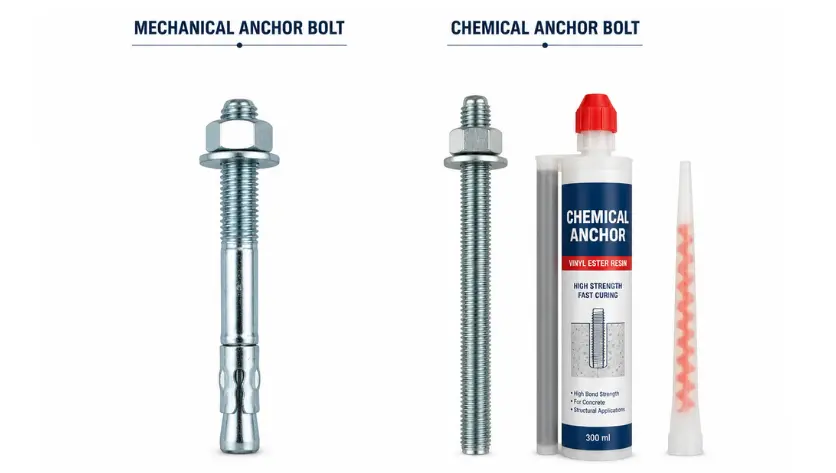
Chemical Anchor Bolts vs Mechanical Anchor Bolts: Ultimate Industrial Selection Guide Request a Quote Selecting the right fastening approach can completely change the structural safety of a commercial project. Engineers face a major choice when securing heavy steel frames to concrete foundations. They must decide between two primary methods. These are chemical anchoring setups and mechanical fastening options. Each solution relies on a completely different physical action to hold structural loads. Mechanical systems grip the concrete using tight friction and physical pressure. Chemical setups use a liquid adhesive resin to create a permanent structural bond along the entire hole. Choosing the wrong fastener can lead to costly foundation cracks or project delays. This guide provides an authoritative look at the technical performance of both systems. It examines real-world strength limits, field handling needs, and local climate factors across the busy industrial landscape of the UAE. Read on to discover how matching the right anchor to your specific base material ensures a safe, durable build that satisfies strict engineering codes. The Structural Engineering Distinctions Between Chemical and Mechanical Systems To correctly choose a securing approach, one needs to examine the way force is transmitted into the foundation’s sheer body. The physical configuration of the holdfast dictates how strain is distributed via the adjacent substrate. Understanding Friction and Mechanical Interlock Forces Mechanical anchor bolts depend wholly on physical grip and interlocking forces within a bored channel. As a tradesperson tightens a mechanical fastener, its collar or expanding part pushes outward against the concrete aperture’s internal surfaces. This tangible expansion generates intense, concentrated stress. This stress keeps the structural element firmly fixed. Understanding Chemical Bond and Adhesion Mechanics In stark opposition, chemical anchor bolts rely on a chemical process to form a long-lasting structural connection. This technique employs a fluid adhesive compound that is applied straight into the bored hole prior to placing a threaded bar. The compound hardens quickly, effectively melding the metal rod right to the concrete substrate. This chemical structure spreads the load uniformly across the full embedment depth of the rod. Consequently, it entirely prevents the development of localized areas of intense pressure. Comprehensive Performance Comparison: Curing Time, Strength, and Base Stress Assessing these anchoring techniques necessitates examining several functional aspects. These encompass the structural strength, the setting durations, and the total load imposed upon the substrate. The table below offers a comprehensive contrast of these performance indicators: High Load Structural Fastening Systems Performance Parameters Engineering Performance Metric Chemical Anchoring Systems (Bonded Anchors) Mechanical Anchoring Systems (Expansion Anchors) Primary Holding Mechanism Full-surface chemical adhesion and chemical cross-linking matrix Concentrated friction expander sleeve expansion and mechanical point interlock Curing Time Requirements Requires temperature-dependent curing time from minutes to several hours Instantaneous load-bearing capacity immediately after torque application Edge Distance Constraints Minimal spacing needed due to zero expansion radial stress forces Significant spacing required to avoid cracking the outer concrete edges Dynamic Vibration Resistance Excellent vibration-damping properties due to the solid resin fill Can loosen over time under severe cyclic loading or heavy dynamic vibration Hole Diameter Sensitivity A flexible system that allows small variations in the drilled hole size Highly sensitive system requiring exact drill bits for proper mechanical friction Analyzing Base Material Stress Profiles The radial push from expansion fasteners forms a lasting stress zone within the concrete. When numerous mechanical fasteners are situated too near one another, their stress zones intersect. This merging heightens the chance of abrupt concrete failure due to breakout. Adhered fasteners completely remove this radial tension, permitting greater weight capacity in more compact spaces. High Load Structural Fastening Systems Performance Parameters Mechanical fixings provide a huge benefit when speed is key, as they bear full structural stresses right away. Chemical anchors necessitate careful waiting on the building site. The person installing must check the surrounding warmth to establish the precise setting duration required before any nut is fastened. Selecting the Best Concrete Anchor Bolts for Heavy Industrial Applications Choosing the right concrete anchor bolts significantly depends on your project’s site specifics and the concrete foundation type. The decision between mechanical and chemical anchors frequently hinges on required spacing and the substrate’s state. Applications Best Suited for Wedge Anchor Bolts Wedge anchor bolts represent one of the most common types of mechanical fasteners used today. They work best in thick, solid concrete structures where you can safely space the bolts far apart. However, mechanical options can cause problems if you use them close to edges. The outward pressure can crack or break weak concrete. Applications Best Suited for Bonded Resin Anchors For projects with narrow edges or close spacing, engineers prefer bonded anchors. These chemical systems work exceptionally well in modified structures or lightweight concrete foundations. Since they do not exert outward expansion forces, they allow you to place multiple fasteners close together. This makes them ideal for securing heavy machinery bases or complex structural frame additions. Technical Specification Comparison for High Tensile Steel Anchor Components Technical Material Specification Chemical Adhesive Stud Assemblies Mechanical Heavy Expansion Fasteners Available Steel Grades ASTM A193 Grade B7, B8, B8M, and ASTM A320 Low Temperature Services Carbon Steel Class 4.6, 8.8, 10.9, 12.9 Corrosion Protective Coatings PTFE Coatings, Hot Dip Galvanized, and Zinc-Nickel Electro-Zinc Plating and Yellow Passivation Standard Size Range M8 to M180 and Custom Fabricated Structural Anchor bolt M6 to M36 and custom expansion fasteners Base Material Suitability High-strength fastening in concrete and solid structures using specialized Mild Steel or Stainless Steel (304/316) elements Joining hollow-section steelwork with limited one-sided access (square, round, or rectangular sections) High Performance Steel Grades and Mechanical Testing Requirements The mechanical capacity of heavy fastening networks depends directly on the metallurgy of the raw steel bars. High industrial projects require strict tracing of materials to confirm they match global design metrics. Testing standard components ensures the safety of structures under sudden high stress and long operational lifespans. Mechanical Tensile and Yield Properties of Industrial Fasteners Steel Grade Specification Fastener Diameter Size Range Minimum Tensile Strength Minimum Yield Strength Minimum Elongation Rate