Everything You Need to Know Before Choosing Metal Fasteners for Your Next Project
Metal fasteners are extremely significant for connecting parts made of plastic, sheet metal, or other materials. Metal screws are stronger, more durable, and more resistant to wear than other fastening kinds. Moreover, they are used to fasten items together in many different shapes, sizes, materials, and applications. Industrial metal fixtures can also be customized according to the specifications of projects.
Light-duty metal attachments are employed in various commercial applications, such as medical gadgets, tactical products, pet buckles, and camping equipment. Heavy-duty fasteners are commonly used in manufacturing and heavy applications, including car and airplane cargo tie-downs. Some of these metal fasteners may hold up to 750 pounds before collapsing.
Fastening industries usually put metal connectors into two groups: those that make a permanent bond and others that need a sliding or releasable bond. Some threaded fasteners that make a permanent connection are screws, rivets, clamps, retaining rings, and bolts. Quick-release couplers and pins are examples of non-permanent fasteners that let parts move while they are still connected.
Types of Metal Fasteners for Manufacturing & Construction
Threaded
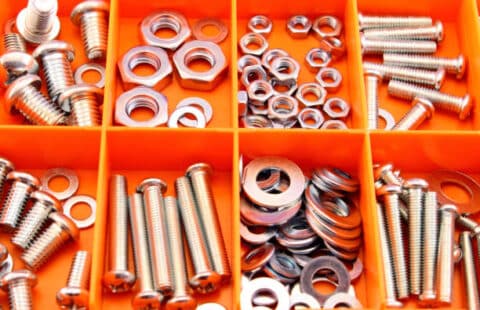
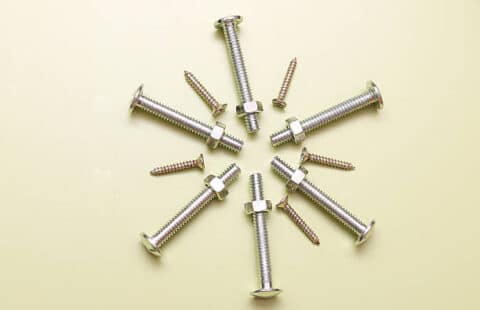
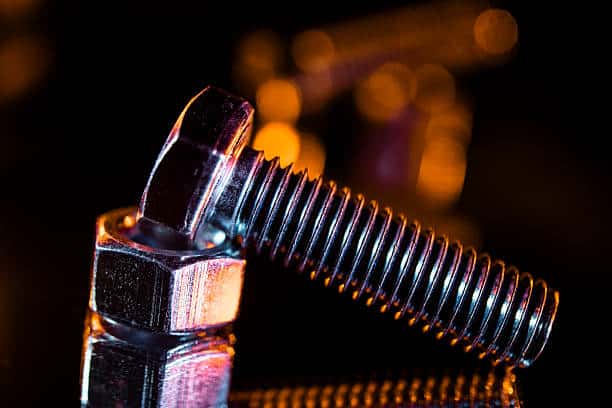
Screws and bolts are the most popular forms of threaded metal fasteners. Standard fasteners have pre-cut threads in the shaft that help the component to securely grip any material. Metal connectors can also be removed from the object by unscrewing it.
Sheet metal screws and bolts usually have threads running along the entire length of the shaft. Whereas wood fasteners typically have threads halfway up.
Although both kinds of threaded fasteners have the same appearance and functionality, there are a few key distinctions. Typically, threaded items are assembled with screws, and non-threaded items are assembled with bolts.
Non Threaded
Non-threaded metal fasteners press down into materials to form a connection rather than requiring a thread to grasp onto them. They are used in structural and automotive applications where permanent or semi-permanent fastening is required.
Industrial fasteners can be inserted into a tight, pre-drilled hole or hammered into place. Additionally, you can also firmly join two or more materials together.
Common examples of non-threaded metal fasteners are rivets, pins, corrugated fasteners, and specialty goods.
Metal Rivets
Rivets are installed as permanent fasteners by cutting a hole into an object that is slightly larger than its diameter. The installation is subsequently wrapped up by hammering the components into their positions or using a specialized tool.
Structural metal fittings have a smooth texture and are commonly used as an alternative to welding.
Weld Fasteners
Weld fasteners are nuts or studs that are designed to be fixed to a sheet metal piece using precise alignment and welding procedures. They have particular flange designs or projections that allow energy to be distributed in a way that will end up in a good weld.
This method is ideal for high loads or applications requiring additional screwed-on elements made of different materials. Weld fasteners do not necessitate the construction of holes for the fastening itself (although locating features may be present), preserving the sheet’s strength.
It is commonly used in automobile frames and bodies, large vehicles and equipment, and industrial machinery.
Corrugated Metal Fasteners
These fasteners are made of metal strips with one polished side and one sharp side bonded in a wavy pattern. When you impale the pointed end into a wood piece, you can connect several wood beams together.
For example, corrugated fasteners fit the bill for tough framing and structural construction.
Specialty Metal Fasteners
Specialty metal fasteners include snap fasteners, high-strength fasteners for industrial uses, along with zippers and metal snaps. They are used to attach textiles and leather.
Here are some more instances of common non-threaded fasteners:
- Nails
- Pins
- Staples
- Dowels
- Keychains
- Grommets and Washers
- Maintaining rings
Common Processing Methods for Metal Fasteners
CNC Machining
CNC machining is one of the most renowned methods in Dubai’s industrial sectors for metal fastener manufacturing. During the procedure, automated machines equipped with several cutting devices cut a bar of raw material to size.
CNC manufacturing enhances precision and accuracy by continuously duplicating the same item without altering its dimensions and quality. This method is faster than traditional grinding technologies.
CNC can quickly modify production by changing the computer code. Additionally, the machines are able to operate continuously for a long time.
Cold Heading
Another option is the cold heading process, which calls for forging metal parts at room temperature. Metal wiring is compressed into a predetermined diameter by a drawing machine during the cold-heading phase. When the blank passes a cold heading machine, it is repeatedly struck between a punch block and a die at high speed, ending in the desired form.
There are many advantages to producing metal fasteners via cold heading:
- Fast manufacturing
- Tensile fasteners due to less stress on the metal framework.
- Lower production expenses
- Flexibility for manufacturing multiple types of fasteners
- The original metal piece cuts to the same volume as the finished fastener, leaving minimal material waste.
Advantages of Using Metal Screws for Durability
- Metal fasteners’ strong tensile strength and load-bearing capacity make them perfect for major structural applications.
- They accurately and firmly keep objects together when there is heat, vibration, or mechanical stress.
- Engineered metal fasteners throughout time retain their strength and shape even when joints are subjected to cyclical pressures.
- Modern metal fasteners let you change the mechanical properties of the metal. For example, its hardness, corrosion resistance along with wear resistance all be adjusted.
- Structural screws make industrial systems easy to install and disassemble while preserving the structural performance of the linked components.
Wrapping Up!
Petrofast Middle East FZC is a certified producer of both standard and special-grade metal fasteners in the UAE. We have a huge inventory of industrial bolts, nuts, washers, and screws readily available in various metal types and grades. Contact us if you want help purchasing custom made and reasonably priced metal fasteners.
FAQs
Are there any custom metal fasteners in the UAE?
Yes, Petrofast UAE produces specialized fasteners for use in automotive and industrial applications. Our custom fasteners are guaranteed to meet the same high requirements as common products through ISO-licensed facilities.
How do I choose the right metal fastener for my project?
Select fasteners based solely on load requirements and environmental exposure along with material compatibility. ISO-certified providers often provide technical requirements to help select the best fastener type.