Stud Bolt Types & Their Applications | Petrofast Middle East FZC
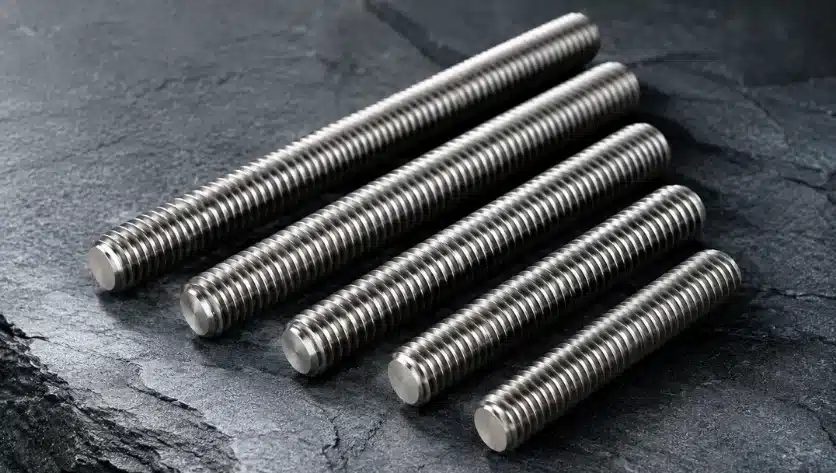
Choosing the Right Stud Bolt Types: Secure Your Systems and Prevent Costly Failures Request a Quote Stud bolt types make all the difference in holding flanges, pipelines and pressure vessels together. Choose wrong and you could be facing leaks, failures and costly downtime. The right one keeps your system safe for years. Every day thousands of critical joints in industries such as oil and gas, power generation and construction across the UAE and wider GCC region are being secured with stud bolt fasteners. But not all stud bolts are equal. This guide covers the most common stud bolt types, as well as the standards they are made to, the materials used to make them and where each is best used. Different Types of Stud Bolts There are several types of stud bolts. Each one is designed for a specific job. Some are used for structural or mechanical applications. Knowing the difference is helpful in choosing the right fastener for the right job. The main types are: Fully Threaded Stud Bolts are threaded from end to end Double-end stud bolts are threaded on both ends with a plain middle section Tap End Stud Bolts have one short end for tapping into a part, and one has a long end for a nut Continuous Thread Studs are used in anchoring and general fastening Each of these serves a different purpose. Petrofast Middle East FZC stocks all of these in a wide variety of materials, grades and finishes. They are available as per ASTM A193/A193M, ASTM A320/A320M, ISO 3506-1 and ISO 898-1 standards. Threaded Stud Bolts Threaded stud bolts are one of the most common fasteners in industrial plants. They are used where a bolt head is impractical or where there is no room for a bolt head. The stud is screwed into a hole on one side and a nut is used on the other side. Petrofast Middle East FZC provides threaded stud bolts in the following grades of material: Material Grade Specifications Standard Material Grades Supported ASTM A193 / A193M B7, B7M, B16, B8, B8M, B8T, B8C, B8MCuLN ASTM A320 / A320M L7, L7M, L43, B8 (Class 1 & 2), B8M (Class 1 & 2) ISO 3506-1 A2-70, A4-70, A4L-70, A4-80, A4L-80 ISO 898 Property Class 4.6, 8.8, 10.9, 12.9 The nuts with industrial stud bolts of Petrofast Middle East FZC are in accordance with ASTM A194/A194M. Classes: 2H, 2HM, GR 7L, 7ML, 8, 8M, 8MA, 8MCuLNA, 8C, 8T. Coatings available: Polytetrafluoroethylene (PTFE) in various colours, Hot Dip Galvanized (HDG), Electro Zinc Plated, Yellow Passivated , Black , Phosphate , Electroless Nickel Plated (ENP) and Zinc Nickel Plated . The coating range makes these threaded stud bolts suitable for corrosive and offshore environments all over the UAE. Flange Stud Bolts Flange stud bolts are used to connect pipe flanges. They are always used in pairs with heavy hex nuts on both ends. These are one of the most critical fasteners in any piping system. Stud Bolts for Flanges are used in UAE and GCC refineries, gas processing plants, water treatment facilities and offshore platforms. The correct stud bolt must be the same as the flange class, pressure rating and temperature range. Petrofast Middle East FZC supplies flange stud bolts UAE operations depend on, following ASME B16.5 flange standards. Stud Bolts for Flanges are being used in UAE and GCC refineries, gas processing plants, water treatment facilities and offshore platforms. The proper stud bolt shall be of the same flange class, pressure class, and temperature range. B7 Stud Bolts B7 stud bolts are the most widely used grade in the oil and gas industry. They are made from chromium-molybdenum alloy steel and heat-treated to give them excellent strength and toughness. According to ASTM A193/A193M, the mechanical requirements for B7 are: Tensile Strength: 125 ksi (860 MPa) for sizes to 2-1/2″ (M64) Yield Strength: 105 ksi (720 MPa) for sizes up to 2-1/2″ (M64 Elongation: Minimum 16% Reduction of Area: 50% Hardness: 321 HBW or 35 HRC Heavy Duty Stud Bolts Heavy duty stud bolts are designed for extreme loads. They are used in structural bolting, bridge construction, heavy machinery and large diameter pipeline joints. These bolts must be able to carry high clamping loads without any stretching or loosening. Surface Finishes are Black, Hot Dip Galvanized (HDG) and Electro Zinc Plated. For structural steel projects in the UAE construction, these high tensile stud bolts meet both inch and metric dimensional requirements. Stud Bolts: Carbon Steel vs Stainless Steel Stainless Steel Stud Bolts and Carbon Steel Stud Bolts are used for different purposes. It depends on the environment in which it will work, the temperature and the type of fluid or gas with which it will deal. Stainless Steel Stud Bolts Petrofast Middle East FZC carries stainless grades ASTM A276 SS304, SS304L, SS316, SS316L, 310, 410 and duplex grades S31803, S32205, S32750 and S32760. gives 75 ksi (515 MPa) tensile strength and 30 ksi (205 MPa) yield. provides the same strength with better resistance to chloride attack. Stainless steel stud bolts UAE applications include desalination plants, offshore rigs, coastal industrial facilities and chemical processing units. The addition of Molybdenum in Grade 316 (Cr 16-18%, Ni 10-14%, Mo 2.0-3.0%) gives the advantage in salt water and acidic conditions. Carbon Steel Stud Bolts Carbon steel stud bolts are the standard choice for general industrial use. They provide greater tensile strength than most grades of stainless steels and at less cost. Grades such as B7 (alloy steel) and B16 (chromium molybdenum vanadium) are in wide application up to 450°C and above in high temperature applications. For carbon steel studs that require corrosion protection, Petrofast Middle East FZC provides coating with PTFE, HDG or ENP in its in-house PTFE coating plant. This is a key advantage of working with a manufacturer who controls the full production chain. Stud Bolt Type Comparison Table The table below compares the main stud bolt types by material, application, grade, and use. Stud Bolt Type Material Application Strength Grade Common Use